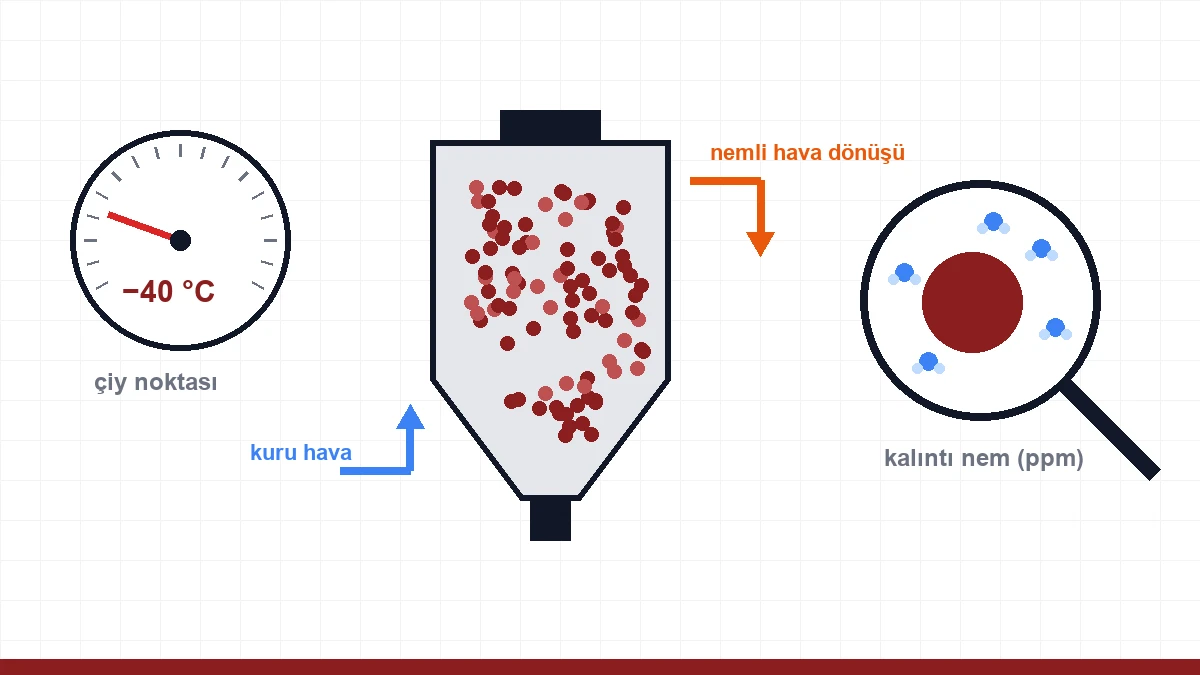
The dryer display shows 80 °C, the fan is turning, the desiccant is working — but is the granulate really dry? The display does not answer this question; measurement does. The cost of hygroscopic material processed damp is often invisible: the part looks sound and breaks in testing. This article explains how to prove whether drying is sufficient — which measurement tells you what, which value to aim for, and how to audit a dryer.
Two separate questions, two separate measurements
There are two measurements in drying verification that get confused with each other, and one does not replace the other:
1. How dry is the air? The dew point tells you this — the quality of the process air the dryer produces. 2. How dry is the granulate? The residual moisture measurement tells you this — the water actually remaining inside the material.
The dew point may be excellent; but if the temperature is low, the time is short or material is drawn from the hopper too early, the granulate is still damp. Conversely, if the granulate has reached the target, what happens on the air side no longer changes the result. A sound operation monitors both: the dew point continuously, residual moisture periodically and whenever there is doubt.
Dew point: the dryer's pulse
The dew point is the temperature at which the moisture in the air begins to condense; the lower it is, the drier the air. In dry air dryers the target is around −40 °C; process air above −20 °C struggles to draw moisture from hygroscopic material. The measurement should be taken on the inlet line of the process air into the hopper — not at the desiccant outlet; ambient air leaking in through the pipes and connections in between (false air) can spoil the dew point.
The course of the dew point tells you more than its individual value. A slight fluctuation with the regeneration cycle is normal; but waves that rise without bottoming out are a sign that the desiccant is aging, and a sudden deterioration is a sign of a valve or seal leak. That is why new-generation dryers have a continuous dew point display; on systems without one, a weekly check with a portable dew point meter is a good start.
Residual moisture: the real verdict is in the granulate
There are three practical ways of measuring the water inside the material on the shop floor:
| Method | How it works | Strength | Limit |
|---|---|---|---|
| Loss-on-weight moisture balance (halogen/IR) | Heats the sample and counts the weight loss as moisture | Fast, affordable, usable by operators | Also counts volatile additives as "moisture"; limited sensitivity at low ppm |
| Karl Fischer titration | Titrates water chemically and selectively | Measures only water — the reference method | Laboratory work; time and consumables cost per sample |
| Calcium hydride / pressure method | The moisture produces gas with a reagent; calculated from the pressure | Portable, on-site measurement at ppm level | Sensitive to sample preparation |
The target values vary by material and the datasheet is authoritative; common guideline thresholds are: for PET preform work 0,005 percent (50 ppm) — this level can only be held with a −40 °C dew point; for PC about 0.02 percent; for ABS 0.1 percent; for PA6/PA66 around 0.1 percent before processing. Moisture above the limit turns into IV loss and loss of strength in PET, and into silver streaks and invisible embrittlement in the others.
Dryer audit: six checkpoints
When in doubt — or as a good habit at every material change — look in this order:
1. Is the dew point on target on the inlet line, and is its course stable? 2. Is the temperature the value measured at the hopper inlet rather than the setting on the display? On long lines the loss along the way can amount to several degrees. 3. Is the residence time sufficient? The amount of material in the hopper divided by the hourly consumption is the real time the material spends in the dryer — we explained the calculation method in our dryer capacity section. If consumption has increased, the time has quietly shortened. 4. The air flow may have fallen because of filter clogging; if the flow falls, the lower part of the hopper is not heated enough. 5. Desiccant condition — are the regeneration temperature and cycle at the manufacturer's values, and when was the bed last changed? 6. Re-moistening after conveying — if dried material is put into an open bucket, or conveyed with damp air through a long line, the effort in the dryer is being lost along the way; the solution is closed-loop conveying and a closed hopper on top of the machine.
Over-drying has a cost too
Drying is not "the longer, the better". PA left for hours longer than needed can yellow and its flow changes; TPU starts to degrade; volatiles escape from additive-containing materials. The symptom is typical: after a long weekend stoppage, the first batch behaves differently "with the same settings". The right practice is to stay within the time band given by the manufacturer and to put the dryer into standby mode during stoppages.
You cannot manage what you cannot measure
The drying chain consists of three links: the right equipment, the right operation, the right measurement. On the equipment side, dry air systems and high-temperature versions for PET-class work are on our drying page; the physics of hygroscopicity and drying values by material are in our drying guide and our processing values table. If you contact our technical team with your measurement results about a problem you suspect is moisture-related, the diagnosis moves much faster.