Gravimetric Dosing Systems Products(7)
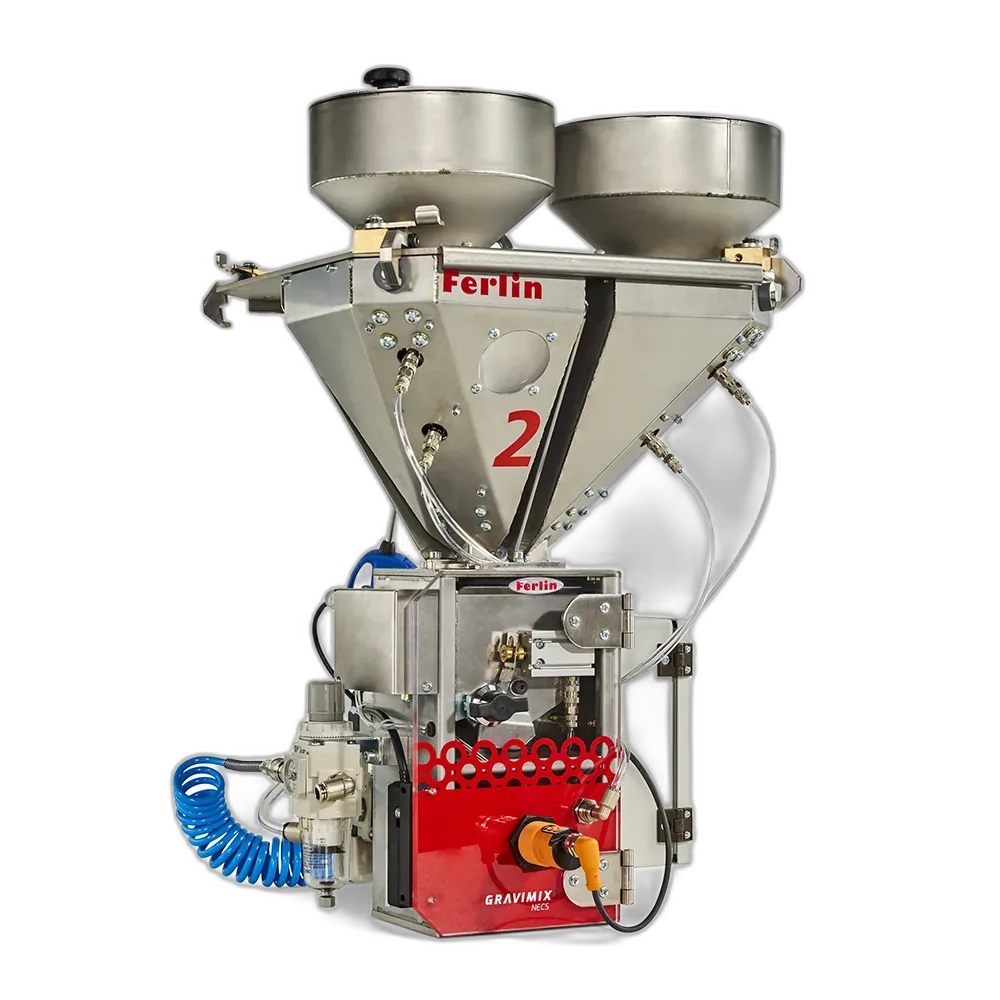 Ferlin Plastics Automation
›GRAVIMIX NECS
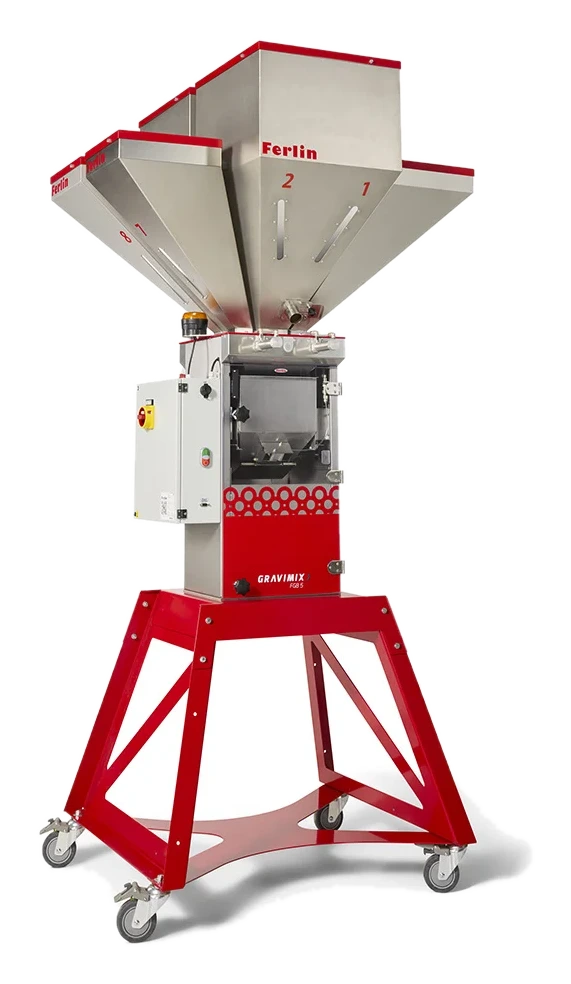 Ferlin Plastics Automation
›GRAVIMIX FGB5
 Ferlin Plastics Automation
›Ferlin One
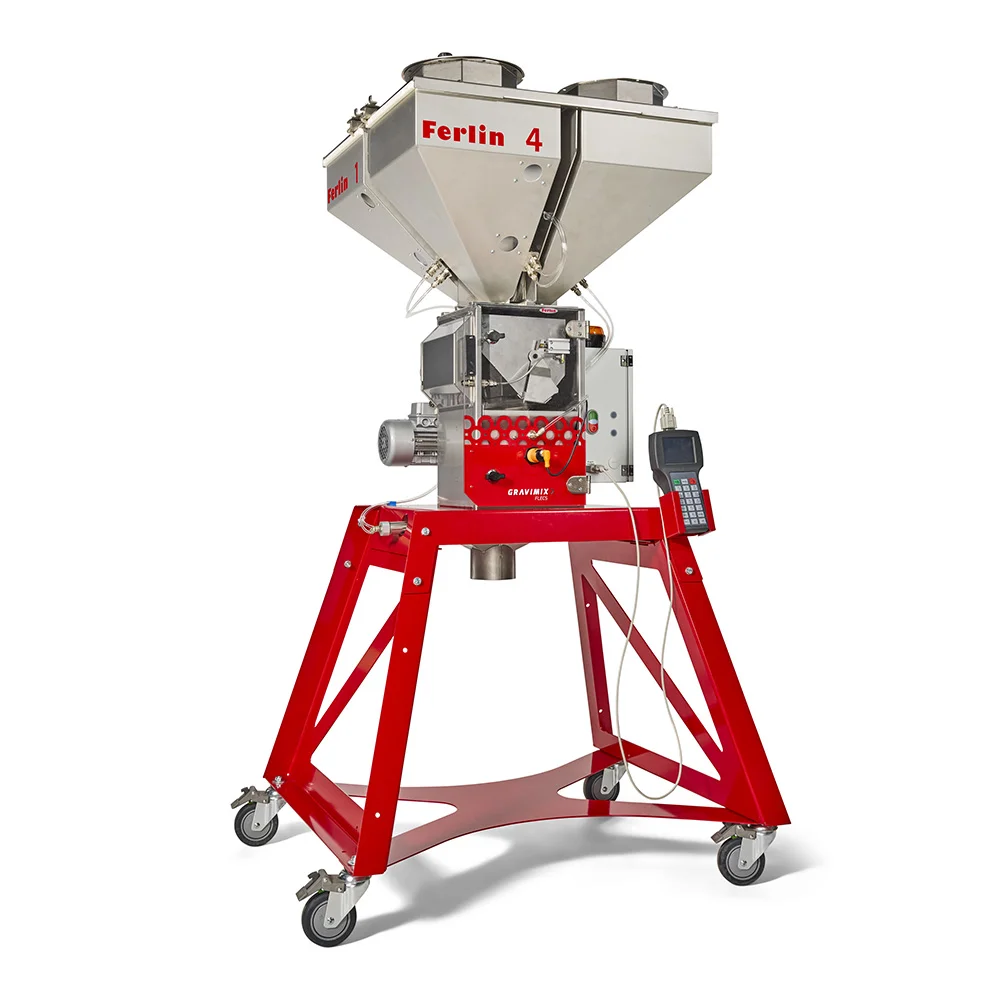 Ferlin Plastics Automation
›GRAVIMIX FLECS
 Ferlin Plastics Automation
›GRAVIMIX FGB10
 Ferlin Plastics Automation
›GRAVIMIX FGB25
 Ferlin Plastics Automation
›GRAVIMIX MECS
What Is Gravimetric Dosing?
Gravimetric dosing means that every component entering the mixture is dosed by being measured by weight. The unit weighs each component one by one in a weighing chamber, moves on to the next one when the ratio in the recipe is reached, and delivers the mixture to the machine after homogenizing it.
In volumetric dosing, the alternative, the measure is not weight but volume: a screw or a slide stays open for a certain time and the amount of material that passes is estimated. This method drifts when the bulk density or the particle size of the material changes — because the same volume is no longer the same weight.
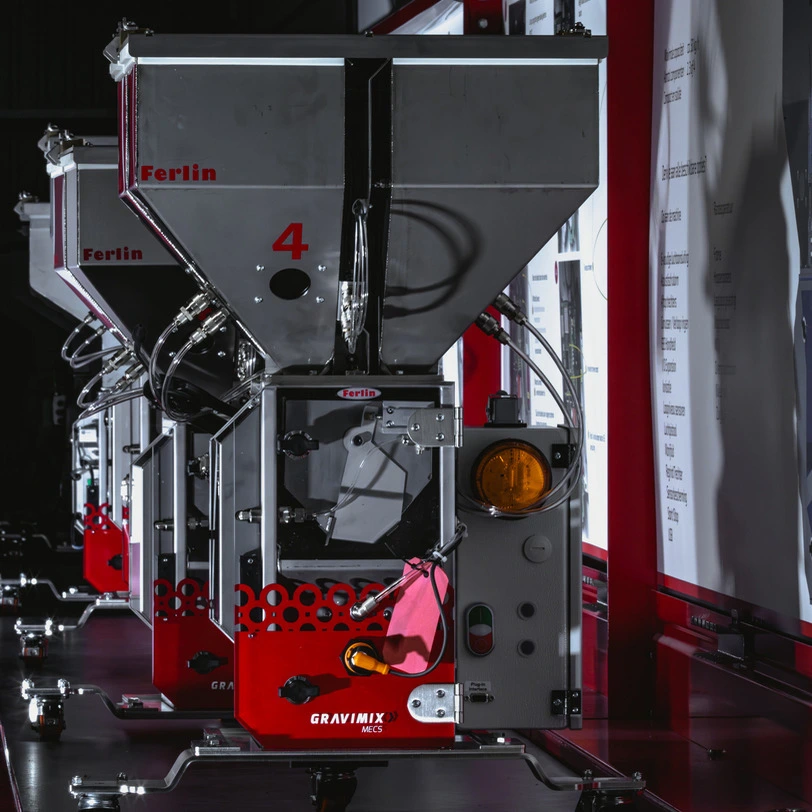
The difference between gravimetric and volumetric
| Gravimetric | Volumetric | |
|---|---|---|
| Unit of measure | Weight (g) | Volume / time |
| Accuracy | Down to the ± 0.1% level | Depends on the material, typically 3 – 10% drift |
| Change in density | Unaffected, corrects automatically | Turns directly into an error |
| Consumption tracking | Actual consumption is recorded | Estimate only |
| Recipe change | A percentage is entered, no calibration needed | Readjustment for every material |
| Initial investment | Higher | Lower |
For a detailed account of the subject: Gravimetric or Volumetric? Dosing Methods
Why gravimetric? Masterbatch saving
In volumetric systems a safety margin is left against the risk of drift: the color or the additive is given somewhat more generously than required. This excess repeats at every cycle.
In gravimetric dosing the drift disappears, so that margin is not needed either. The masterbatch ratio can be brought down to the level of the real requirement — a saving made on the most expensive component pays the system back in a short time. Scrap and customer complaints caused by color deviation also fall, because dosing consistency increases.
Since the actual consumption data is recorded, the cost per part can also be calculated clearly for the first time.
Use of regrind
One of the most tangible benefits of a gravimetric system is the controlled use of regrind. Because the density and the particle size of regrind change from batch to batch, holding the ratio in volumetric dosing is close to impossible.
As the gravimetric unit doses regrind by weighing it as well, the ratio in the recipe is preserved at every cycle. Thanks to the adjustable regrind priority circuit, regrind is returned to production in a balanced way, before stock builds up. On this subject: Regrind and scrap recovery
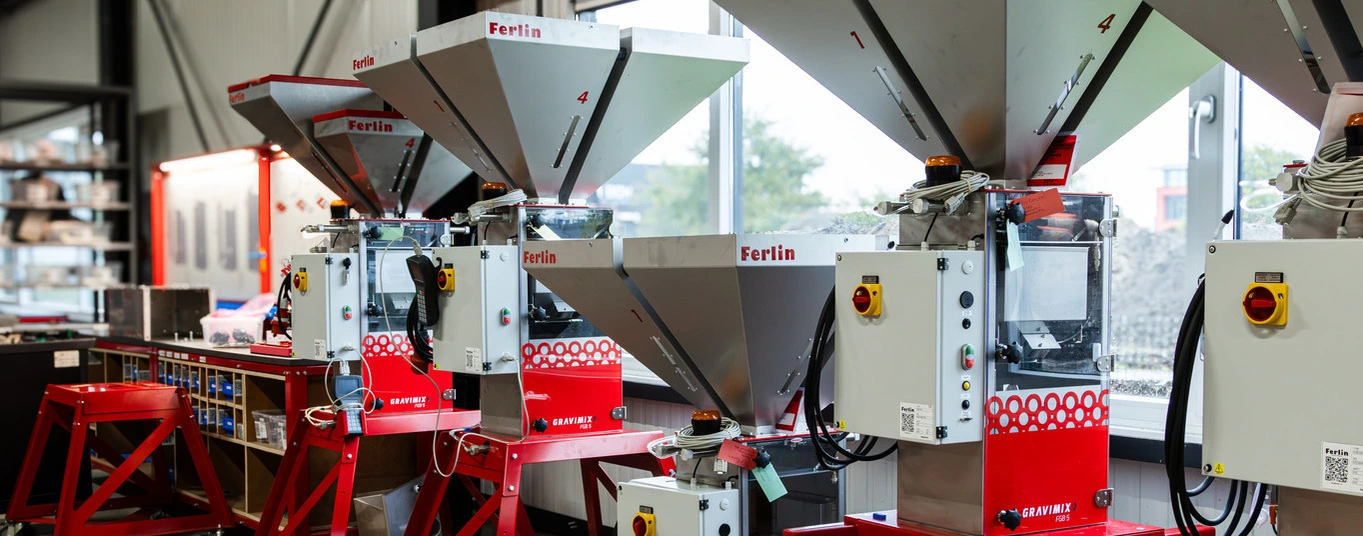
Series selection by capacity
| Series | Max. capacity | Components | Batch weight | Typical use |
|---|---|---|---|---|
| Ferlin ONE | 0.1 – 25 kg/h | Single additive | — | Belt dosing, masterbatch in very small amounts |
| GRAVIMIX NECS | 50 kg/h | 4 | 0.2 kg | Small machines, precise additive dosing |
| GRAVIMIX MECS | 170 kg/h | 4 (+ regrind) | 0.7 kg | Medium machines, the most widely used series |
| GRAVIMIX FLECS | 350 kg/h | 6 (+ regrind) | 1.8 kg | Recipes with many components |
| GRAVIMIX FGB5 | 1,100 kg/h | 8 (+ regrind) | 5.7 kg | Large machines, central feeding |
| GRAVIMIX FGB10 | 2,000 kg/h | 7 (+ regrind) | 10 kg | High capacity lines |
| GRAVIMIX FGB25 | 3,210 kg/h | 8 (+ regrind) | 25 kg | Extrusion and central blending |
How is the right unit selected?
1. Hourly throughput — the real consumption of your machine (kg/h). The unit capacity is selected above this figure. 2. Number of components — natural, color, additive and regrind each require a separate station. If a component will be added later, take it into account from the start. 3. Batch weight — a small batch doses small amounts more precisely; a large batch gives higher capacity. 4. Smallest dosing ratio — if there are additive ratios as low as 0.5%, a precise screw feeder is required. 5. Use of regrind — a model with a regrind circuit and a priority setting should be selected. 6. Installation point — on the machine throat, on a platform, or as a central blender. 7. Material temperature — if feeding will be done directly from the dryer, a heat-resistant model is required (FGB series, 120 °C).
GRAVIMIX technology
All components are in contact with wear resistant stainless steel parts. Because the system calibrates itself, sample dosing is not needed for a new material; on a color or material change the unit can be dismantled and cleaned without tools (EasyClean).
The microprocessor-controlled closed loop continuously monitors all dosing and weighing functions; deviations are detected and compensated immediately. Total dosing accuracy goes up to ± 0.1%. With a maximum of 10 stations a capacity of 2,500 kg/h is reached.
For daily use of the unit, recipe entry, calibration and alarm solutions: [Gravimix User Guide](/en/gravimix-manual)
Ferlin Plastics Automation
GRAVIMIX is manufactured by Ferlin Plastics Automation, based in the Netherlands. Used on more than 10,000 machines worldwide, the system suits injection molding, extrusion, blow molding and central blending applications.
For model selection suited to your application and to request a free trial you can reach our technical support team.
What determines the price of a gravimetric dosing system?
Three main variables determine the price in dosing systems: capacity (kg/h), number of components and weighing accuracy. The items added to these are as follows:
- Number of components — every additional component means its own chamber, dosing valve and calibration
- Capacity — a unit dosing 0.1 kg/h and a system feeding 3,000 kg/h are different classes
- Load cell resolution — the decisive item in dosing masterbatch at low ratios
- Control and reporting — touch screen, consumption report, production record and communication with the machine
- Blender and cleaning equipment — in plants with frequent color changes, a tool-free dismantling design shortens the time directly
The point to note in this investment is that the price of the unit stays small against the saving in raw material. The masterbatch given in excess as a safety margin in volumetric dosing is a cost paid silently throughout the year; because the gravimetric system removes that margin, the investment usually pays for itself in a short time. To make the calculation with your own consumption you can look at the raw material item in the cost per part article.
It is enough to share the number of components in your recipe and your target capacity; we will determine the suitable series and prepare a price study.
Frequently asked questions
Why gravimetric instead of volumetric dosing? A volumetric unit measures volume, not weight. When the granulate size, the bulk density or the regrind ratio changes, the same volume corresponds to a different weight and the ratio shifts. A gravimetric system weighs every dose; the full comparison is in the article on the difference between gravimetric and volumetric dosing.
At which ratios is precise dosing required? With low-ratio additives such as masterbatch the margin of error grows in percentage terms; in applications working in the 1 – 2% range a weighing system is in practice mandatory. In high-ratio mixtures the real gain is consumption tracking and repeatability.
Can regrind be dosed? Yes, gravimetric systems can manage regrind as a separate component and hold its ratio steady. The limits of regrind use are covered in the article on regrind and scrap recovery.
How long does a color change take? It depends on the cleaning design of the unit. A chamber and blender that can be dismantled without tools shorten the changeover time noticeably; the whole subject is in the article on color and material change.
For a comparison of the GRAVIMIX series, their shared features and the user guide, see the GRAVIMIX brand page.