Mold Temperature Control Units Products(9)
 RUMMEL
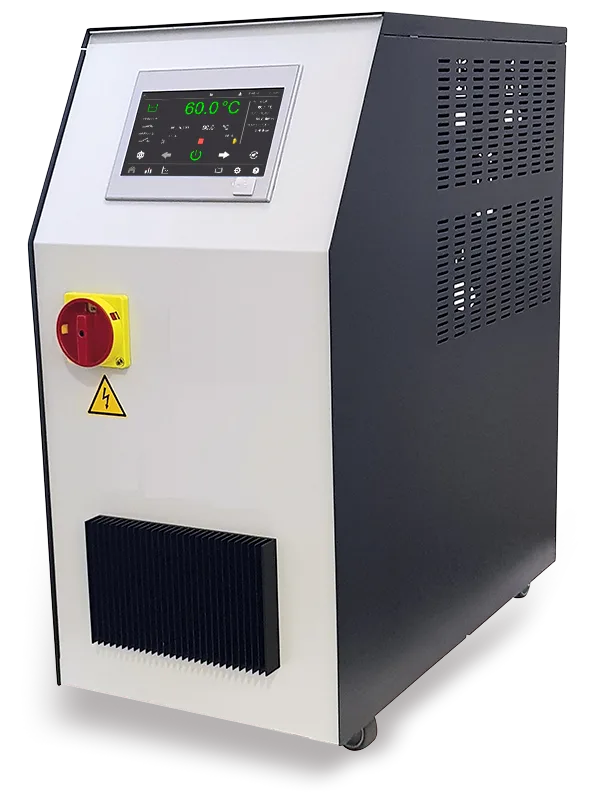
›Serie TEMP 90°C — Water Temperature Control Unit
RUMMEL›Serie TEMP 160°C — Pressurized Water Temperature Control Unit
RUMMEL›Serie TEMP 140°C — Pressurized Water Temperature Control Unit
RUMMEL›Serie TEMP 120°C — WDC Temperature Control Unit
 RUMMEL
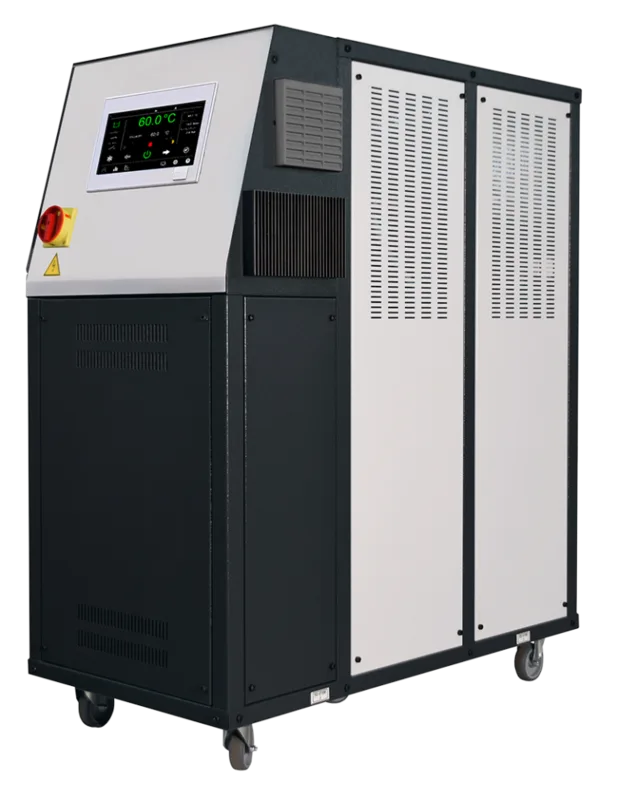
›Serie TEMP 300°C OIL — Oil Temperature Control Unit
RUMMEL›Serie TEMP 200°C OIL — Oil Temperature Control Unit
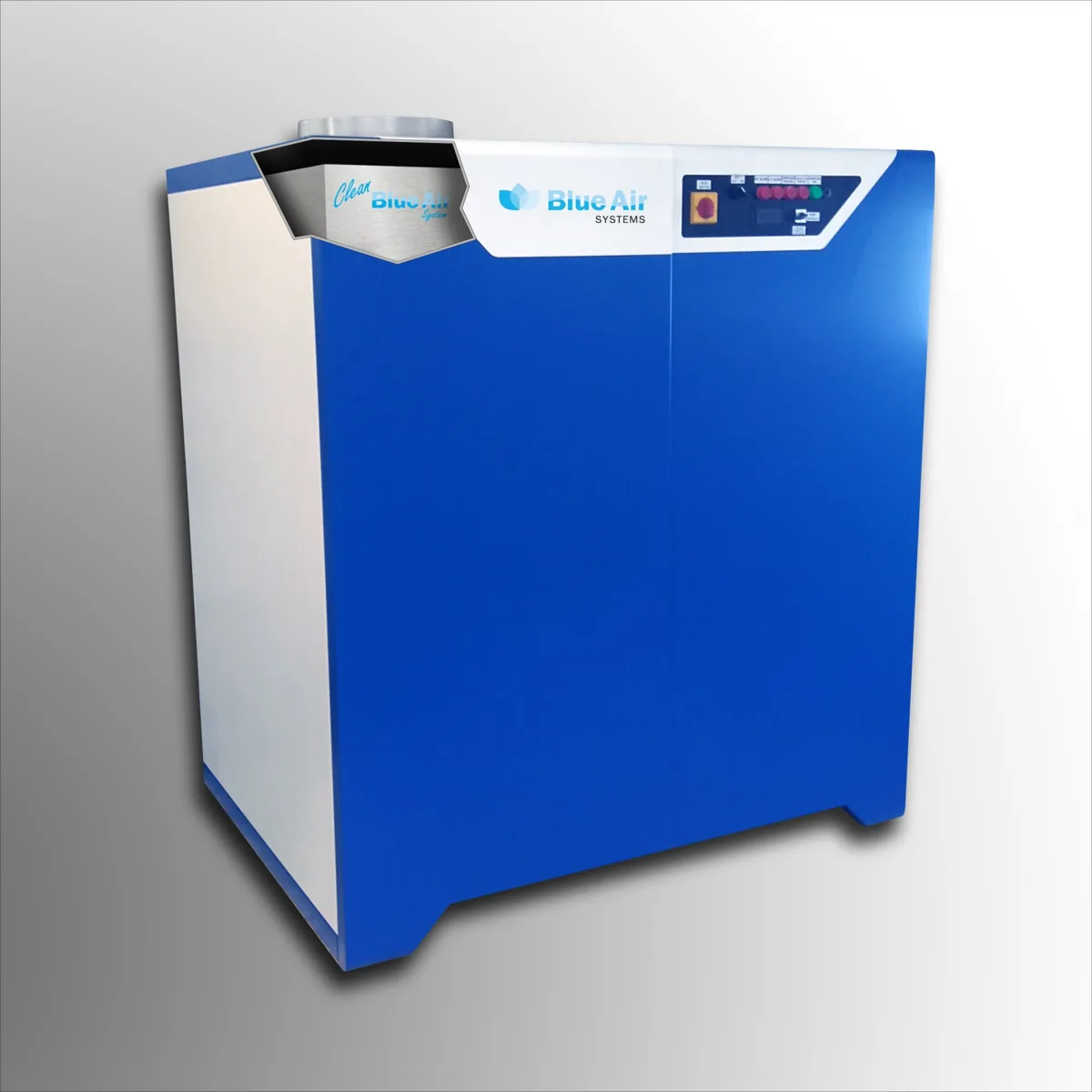 Blue Air Systems
›Mold Dehumidification Systems
What Is a Mold Temperature Control Unit?
A mold temperature control unit (mould temperature controller / Temperiergerät) is the device that keeps the temperature of a plastic injection mold constant and uniform throughout production. It pumps fluid (water or heat transfer oil) at a controlled temperature into the temperature control channels inside the mold; it takes the heat coming from the mold and supplies heat when needed.
A common misconception is that the unit only "heats the mold". In reality it works in both directions: during the filling and holding phase of the cycle it gives heat to the mold, and during the solidification phase it draws the heat coming from the melt. The unit that establishes this balance determines the cycle time and the part quality at the same time.
What does mold temperature change?
| Mold temperature | Effect |
|---|---|
| Too low | The melt freezes early → short shot, the weld line becomes pronounced, the surface stays matt, internal stress increases |
| Too high | Solidification takes longer → the cycle time lengthens, the risk of sink marks and flash increases, deformation during ejection |
| Unbalanced (difference between mold halves) | Warpage — the part bends towards the cold side |
Mold temperature directly affects the shrinkage rate, the dimensional stability, the surface gloss, the internal stresses and the cycle time. In semi-crystalline materials (PA, POM, PBT, PEEK) it also determines the degree of crystallinity and therefore changes the mechanical strength.
Every material has its own mold temperature range — you can find the values for 45 thermoplastics in the material processing data table.
Water-based or oil-based?
| Water (pressurized water) | Oil (heat transfer oil) | |
|---|---|---|
| Temperature range | 90 – 160 °C | 200 – 300 °C |
| Heat transfer coefficient | High — faster response | Low — slower response |
| Operating principle | The boiling point is raised under pressure | High temperature at atmospheric pressure |
| Maintenance | Scale and corrosion control | Oil change, monitoring of seals |
| Typical use | Packaging, automotive, technical parts, white goods | PEEK, PPS, LCP, high temperature PA, hot runner manifolds |
Practical rule: if you can manage up to 160 °C, prefer water — it is faster, cheaper and cleaner. Oil is only needed at the temperatures water cannot reach.
For a detailed account of the subject: What Is Mold Temperature Control? Water-Based and Oil-Based Systems
Series selection by temperature range
| Series | Range | Fluid | Typical use |
|---|---|---|---|
| TEMP 90 °C | up to 90 °C | Water | Standard injection molding, packaging, general purpose |
| TEMP 120 °C WDC | up to 120 °C | Water (direct cooling) | Cycles that require fast temperature change |
| TEMP 140 °C | up to 140 °C | Pressurized water | Technical parts, semi-crystalline materials |
| TEMP 160 °C | up to 160 °C | Pressurized water | PA, PBT, tight shrinkage control |
| TEMP 200 °C OIL | up to 200 °C | Heat transfer oil | High temperature engineering plastics |
| TEMP 300 °C OIL | up to 300 °C | Heat transfer oil | PEEK, PPS, LCP, PEI; hot runner manifolds |
Communication with the injection molding machine
In modern production it is not enough for the temperature control unit to work on its own; it has to talk to the machine. Rummel units offer broad interface support for this:
- OPC-UA, Profinet, Modbus, Ethernet, RS485 / RS232 / TTY 20 mA
- Analog 4–20 mA transfer of the set value and the actual temperature
- Ready / fault signal to the machine over digital input/output
- Direct integration into the mold platen
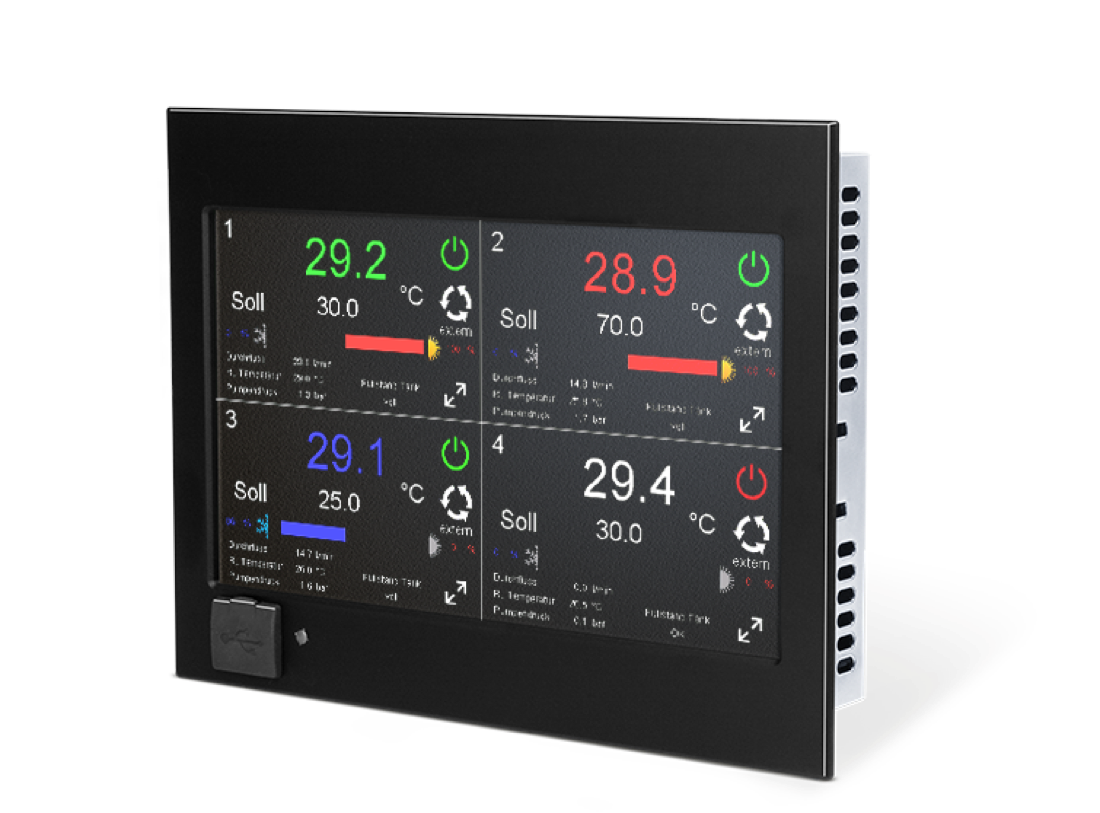
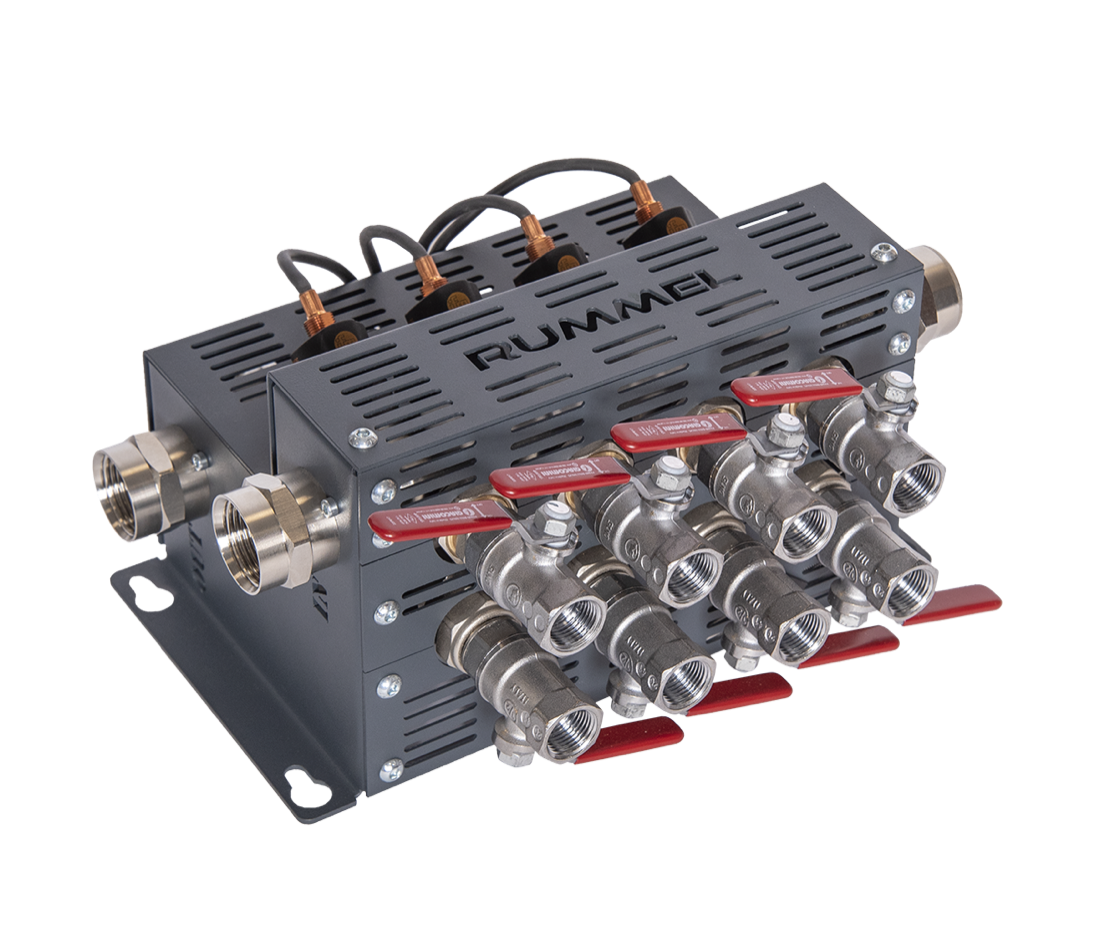
- Multi-circuit distribution (Mehrkreis-Verteiler) — several temperature control circuits from a single unit
In this way the mold temperature is set automatically on a recipe change, deviations are recorded on the machine side and production data is transferred to the central system (Industry 4.0).
How is the right unit selected?
1. Target mold temperature — the range the material requires determines the fluid (water ≤160 °C, oil above that). 2. Heating power (kW) — according to the mold mass and the heat-up time. Insufficient power means a long wait at the first start-up. 3. Cooling capacity — this is usually the real determinant; the heat coming from the melt during the cycle has to be removable. 4. Pump flow rate and pressure — according to the channel cross-section, the length and the number of circuits in the mold. Insufficient flow creates a temperature difference between inlet and outlet on the mold. 5. Number of circuits — in multi-cavity or large molds a single circuit is not enough; a multi-circuit distributor or separate units are required. 6. Communication — if integration with the machine is planned, the protocol has to be chosen from the start.
Rummel Kunststofftechnik
Rummel Kunststofftechnik GmbH (Germany) manufactures compact and highly efficient units across the whole performance range, up to 180 °C in water applications and up to 300 °C in heat transfer oil applications. Self-optimizing PID control, a 7" touch screen, limit value monitoring and maximum temperature protection are standard.
For a unit selection suited to your application you can reach our technical support team.
What determines the price of a mold temperature control unit?
Prices of temperature control units differ noticeably according to the temperature the unit can reach and its circuit capacity:
- Temperature range — a water unit of 90 °C and an oil unit going up to 300 °C are in different material and sealing classes
- Heater power and pump flow rate — both grow as the thermal mass of the mold grows
- Cooling type — a direct cooling (WDC) design and a design with a heat exchanger have different costs
- Number of circuits — there is a serious difference between a single-circuit unit and a system with a multi-circuit distributor
- Communication equipment — the ability to connect to the injection molding machine over OPC-UA, Profinet or Modbus
Oil units are more expensive than water units; for that reason not going to oil unless it is necessary is the right approach. If your mold temperature stays within the range water covers safely, a water unit is both the more economical and the faster responding solution.
If we know your target mold temperature and how many circuits are needed, we can recommend the right unit on the water or the oil side and present a quotation.
Mold sweating and dehumidification
When the mold water falls below the dew point of the ambient air, the mold sweats. To keep the mold cold and prevent sweating, mold dehumidification systems are used together with the temperature control unit.
Frequently asked questions
Should I buy a water or an oil mold temperature control unit? The determining factor is the target mold temperature. Pressurized water systems cover a wide range and their heat transfer is better than oil. With high temperature engineering plastics such as PEEK, PPS and PEI, an oil unit is required. The full comparison is in the article on the difference between water and oil.
Does the unit heat the mold or cool it? It does both. During the filling and holding phase it gives heat to the mold, and during the solidification phase it draws the heat coming from the melt. The job of the unit is to keep the temperature constant.
How much does mold temperature affect the cycle time? It affects it directly; cooling is the longest part of the cycle. Lowering the mold temperature shortens the cooling but increases the risk of internal stress and warpage. The balance calculation is covered in the cycle time article.
How many molds does one unit cover? It depends on the number of circuits. In multi-cavity or large molds different zones may require different temperatures; in that case a multi-circuit distributor is used and every circuit is monitored separately.
For the complete Rummel range, the water-oil comparison and the communication features you can look at the RUMMEL brand page.