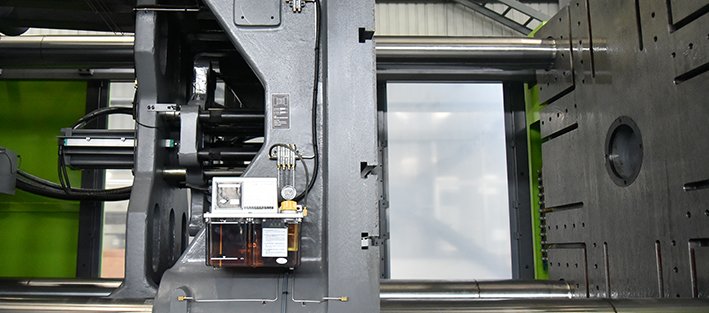
A plastic injection molding machine is a production machine that heats and melts plastic raw material in granule form, fills it into a mold cavity under pressure, and ejects the part from the mold once it has cooled and solidified. Most of the plastic parts around you are produced by this method: phone cases, syringes, buckets, car bumpers, caps, connectors.
What sets the method apart from other plastic forming methods is its ability to produce the same part with high repeatability and in short cycles. Once the mold has been made, production begins that repeats in a matter of seconds.
How does it work? The stages of the injection cycle
An injection cycle consists of six stages, and these stages repeat continuously:
| Stage | What happens | What determines the time |
|---|---|---|
| 1. Mold closing | The moving platen closes the mold and the clamping force is applied | Mold weight, stroke distance |
| 2. Injection (filling) | The screw moves forward and presses the melt into the mold cavity | Injection speed, gate cross-section |
| 3. Holding | Pressure is maintained to compensate for shrinkage as the part cools | Gate freeze time |
| 4. Cooling and plasticizing | While the part solidifies, the screw rotates back and prepares the next shot | Wall thickness, mold temperature |
| 5. Mold opening | The clamp is released and the mold halves separate | Opening stroke |
| 6. Ejection | The ejectors separate the part from the mold | Part geometry, draft angle |
The fourth stage is particularly important. Cooling usually takes up more than half of the cycle time, and because plasticizing runs in parallel with this time, it does not lengthen the cycle. That is why most time-reduction work concentrates on the cooling side.
The parts of the machine
Injection unit
The unit where the raw material is melted and pressed into the mold. The granulate drops from the hopper into the barrel; the screw turning inside the barrel both carries the material forward and melts it with frictional and heater heat. The non-return valve at the tip of the screw stops the melt from slipping back during injection — this small part directly determines the consistency of the shot weight.
Two values define the capacity of the unit: screw diameter and injection volume. The shot weight is expected to stay within about 20 – 80% of the screw capacity. With very small shots the material waits a long time in the barrel and degrades; with very large shots no cushion is left for holding.
Clamping unit
The unit that holds the mold closed against the injection pressure. Its capacity is expressed in tons and it is the first criterion in choosing a machine. If the clamping force is insufficient, the mold opens slightly at the moment of filling and flash comes out of the parting surface.
Mechanically there are two main designs: toggle systems are fast and energy-efficient; two-platen systems offer a longer opening stroke and a more compact body for large molds.
Control unit
The unit that manages the temperature, pressure, speed and position parameters. Repeatability is largely its job; being able to produce a thousand parts with the same parameters depends on the precision of the control unit.
Drive system
Determines how movement is produced and is the main determinant of energy consumption. Servo hydraulic systems run the pump only when needed; all-electric machines have no hydraulic oil at all, and every movement is made by servo motors.
What does tonnage mean?
When a machine is referred to as "180 tons", this expresses the highest force the clamping unit can apply. To understand why this force is needed, you have to look at what happens at the moment of filling.
As the melt fills the mold cavity, it exerts pressure on the mold surfaces, and this pressure tries to open the mold. The job of the clamping unit is to overcome this opening tendency and keep the mold closed. If the force is insufficient, the mold separates by microns at the moment of filling and flash comes out of the parting surface; the operator often takes this for a mold fault, when the problem is actually the size of the machine.
Two practical conclusions follow:
- What decides it is not the weight of the part but the area it presents perpendicular to the mold opening direction. A thin but wide lid can require a higher tonnage than a heavy but small part
- The type of material also changes the force; plastics with low flowability need higher pressure to fill the mold
There is a limit in the opposite direction too. The idea that "a big machine does every job" is a common misconception: oversized tonnage permanently raises the investment and the energy bill, and because the material waits a long time in the barrel with small shots, it breaks the screw capacity limit described above.
You can calculate the force your own part requires with the tonnage calculator.
Which materials are processed?
Almost all thermoplastics can be injection molded. The most common are PP, PE, PS, ABS, PA (nylon), PC, POM, PET and TPE. The type of material affects not only the temperature settings but also the machine equipment:
- Hygroscopic materials (PA, PC, PET, ABS) must be dried before processing
- Corrosive materials (PVC) require special screw and barrel materials
- Abrasive fillers (glass fiber) shorten screw life and call for hardened equipment
Why is it so widespread?
The strengths of the method are its ability to produce complex geometry in a single step, high repeatability, low labor per part and the recoverability of runner material.
On the other hand, the mold cost is high, and this cost is divided by the production quantity. That is why injection molding is not economical for low-volume jobs; the logic of the method rests on series production.
The machine alone is not enough
The injection molding machine is the center of a line but not its only part. If the raw material is damp, even the best machine produces defective parts; if the color ratio drifts, the part color does not match; if the mold temperature is uncontrolled, the part warps.
A complete line includes the following links: raw material conveying, drying systems, dosing, mold temperature control, hot runner control for multi-cavity molds, and quick mold clamping to shorten change times.
Next step
Once it is clear what the machine is and how it works, the next step is to determine the tonnage and series suited to your needs. All models are listed with their tonnage bands on our plastic injection molding machine series page; the article that goes through the selection criteria step by step is how to choose a plastic injection molding machine.
If you are interested in shortening cycle time, see the cycle time guide; if you want to calculate production cost, see the cost per part calculation article.
Frequently asked questions
What is an injection molding machine?
A machine that heats and melts plastic granulate, injects the melt at high pressure into the cavity of a closed mold, and ejects the part from the mold once it has cooled and solidified. It consists of three main units: the injection unit, which does the plasticizing and injection; the clamping unit, which keeps the mold closed against the pressure; and the control unit, which manages both.
Injection molding machine or injection moulding machine?
Both are used. Molding is the US spelling and moulding the UK spelling; they describe the same machine. There is no technical difference, and both spellings appear in catalogs and quotations.
What is produced with an injection molding machine?
Automotive interior and exterior parts, housings and lids for household appliances, packaging (caps, buckets, crates), electrical and electronic enclosures, medical disposables and PET preforms. The common denominator is this: if the same part must be produced in large numbers and to tight tolerances, the method is injection molding.
How many types of injection molding machines are there?
By drive type there are hydraulic, servo-hydraulic and all-electric machines; by design, three-platen (toggle) and two-platen machines; and by application there are special series such as PET preform, PVC, medical and thin-wall. The same tonnage can appear in more than one series; what decides is not the tonnage but the application.
How many tons of injection molding machine do I need?
The area of the part projected onto the mold parting plane is multiplied by the cavity pressure the material requires; the number of cavities and the runner are added, and a safety margin is added on top. The resulting value is the required clamping force and determines the tonnage of the machine.
What determines the price of an injection molding machine?
Tonnage, drive type, size of the injection unit, application-specific equipment, level of automation, and the scope of commissioning and warranty. Because of these items there can be a considerable difference between two machines of the same tonnage; comparison is not made by tonnage alone.