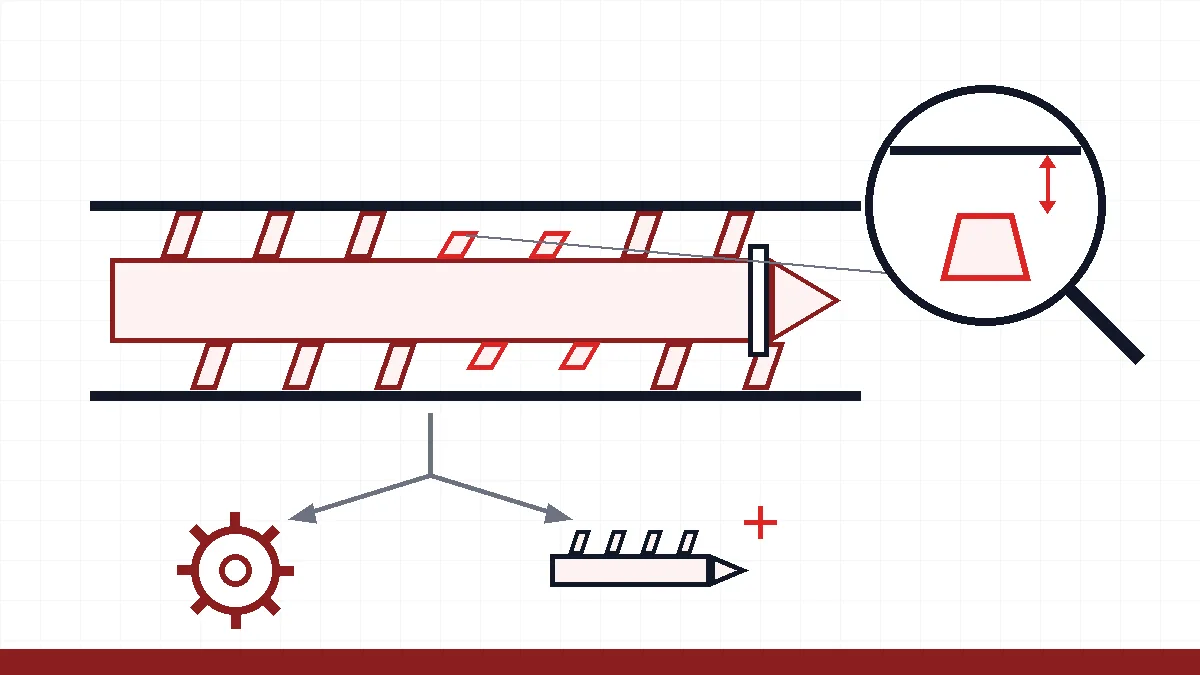
In our screw and barrel wear article we explained how wear arises and how it is diagnosed. This article is about the next step: the clearance has been measured and the values have come out at the limit — what now? In most plants the refurbishment decision is made later than it should be, because the bill for wear does not come as a single item but spread across three separate expense lines, and none of them has "screw" written on it.
The invisible bill for postponing
Production does not stop with a worn plasticizing unit; it just quietly becomes more expensive. Through three channels:
- The cycle lengthens. As the metering time lengthens because of melt slipping back over the flight, plasticizing comes out of the shadow of the cooling time and starts to determine the cycle. You can see the annual cost of an extension of a few seconds with your own figures using our part cost calculation.
- Scrap increases. Cushion fluctuation shows up on the part as short shots and sink marks; the operator increases holding pressure to compensate, and this time the flash limit is approached.
- Energy is wasted and the material degrades. The back pressure raised to suppress the leakage both increases the motor load and shears the melt unnecessarily; material waiting in dead zones turns into a source of black specks.
The decision is a comparison between the sum of these three items and the cost of refurbishment — and the sum is often larger than thought, because scrap is not just waste but unsellable product on which all the energy and machine hours have already been spent.
Blame the right part first: the non-return valve
The most common mistake in the refurbishment decision is looking for the problem in the screw. If the cushion does not hold and the shot does not repeat, the first suspect is the non-return valve: this three-part set at the tip of the screw (ring, seat, tip) is the fastest-wearing element of the system, and replacing it on its own costs a small fraction of a complete screw renewal. If the clearance measurement on the screw body comes out reasonable but metering is unstable, starting with the valve set is both a cheap and a fast diagnostic step: if the instability disappears after the change, the screw has gained another production season.
Refurbishment options: not every wear calls for the same recipe
| Option | When it makes sense | Watch out for |
|---|---|---|
| Non-return valve set | Metering unstable, screw clearance reasonable | Choose the valve type according to the material; PVC has its own geometry |
| Screw surface renewal (hardfacing weld + grinding) | Wear concentrated on the flight tips, body sound | Not every screw type is suitable for welding; ask for a measurement report after the work |
| New screw — same geometry | The geometry suits the process, only its life has run out | If there is no original drawing, the dimensions must be taken from the existing screw |
| New screw — geometry upgrade | Color change slow, melt not homogeneous, capacity at the limit | The new geometry requires the process parameters to be reset |
| Barrel honing / sleeve | Wear localized in the barrel | Honing enlarges the diameter; the screw-barrel pair must be assessed together |
| New barrel (bimetallic) | Permanent move to filled/corrosive material | Must be checked together with the feed zone cooling |
The most important row in the table is actually a principle: the screw and barrel are a pair. Renewing only the screw and running it in a worn barrel takes away from the life of the new part from the start; the measurement must always cover both together.
Refurbishment is not a copy but a chance to improve
If the screw is coming out anyway, you do not have to go back to the same geometry. A standard three-zone screw "manages" every job but is the best at none. A barrier screw carries solid granules and melt in separate channels, stopping unmelted granules from getting into the melt — because homogeneity increases, melt of the same quality is obtained with lower back pressure. Mixing tip sections provide more effective masterbatch dispersion that shortens color change time. For a plant moving permanently to glass-fiber material, the right answer is often not a hardened copy of the same screw but a bimetallic screw with a geometry that reduces fiber breakage. Special processes such as foam injection molding require their own screw design — on the MuCell side this is part of the technology.
Planning: a screw does not wait on a shelf, so don't make yourself wait
The delivery time of a custom-made screw and barrel set is measured in weeks. That is why the timing of the refurbishment decision should be based on the measurement trend, not on the day of the breakdown: if the rate of clearance increase is known, the order date for the set can be calculated backwards. For a critical machine tied to a single mold, the safest strategy is, at the next renewal, not to throw the old one away completely but to put it through surface renewal and keep it on the shelf as a spare set — in an unplanned stoppage, the change then takes hours instead of days.
Do not skip verification after installation: an idle plasticizing test, followed by a shot consistency measurement by weighing shots in succession. The new set should be run not with the old parameters but with reset back pressure and screw speed.
For screws, barrels, non-return valves and heater bands, you can get support from our spare parts page, and from our technical team for the measurement and decision stage.