In a cold runner mold, every shot produces a runner along with the part: it is trimmed, ground and, at best, becomes regrind. A hot runner system eliminates this waste at the root — the melt never freezes until it enters the mold cavity.
Working Principle
A hot runner system consists of a heated distribution block (manifold) and nozzles embedded in the mold. The plastic is kept at melt temperature all the way from the machine nozzle to the part gate. No frozen runner forms; the part separates cleanly at the gate.
Each zone (the manifold, each individual nozzle) is equipped with its own thermocouple and heater; the hot runner controller holds each of these zones at the target temperature with a separate PID loop.
Gains over a Cold Runner
- Material savings: Runner scrap is reduced to zero. In small parts the runner can be 30–50% of the shot weight — this is a direct raw material gain
- Short cycle: There is no need to wait for a thick runner to freeze; the cycle is usually determined by the part rather than the runner
- Ease of automation: The steps of separating, trimming and grinding runners disappear
- Quality: The gate mark is minimized, pressure loss is reduced, and more balanced filling of distant cavities is achieved
The price: The mold investment rises, the system needs maintenance, and color changes take longer than with a cold runner. In high-volume production the calculation always favors the hot runner; at very low volumes a cold runner can still make sense.
Temperature Control: The System's Insurance
The performance of a hot runner depends on how precisely the zone temperatures are held. A deviation of 10 °C in one zone means color differences, stringing or a frozen nozzle in that cavity.
In the FIEGE controller family we offer levels to suit the need:
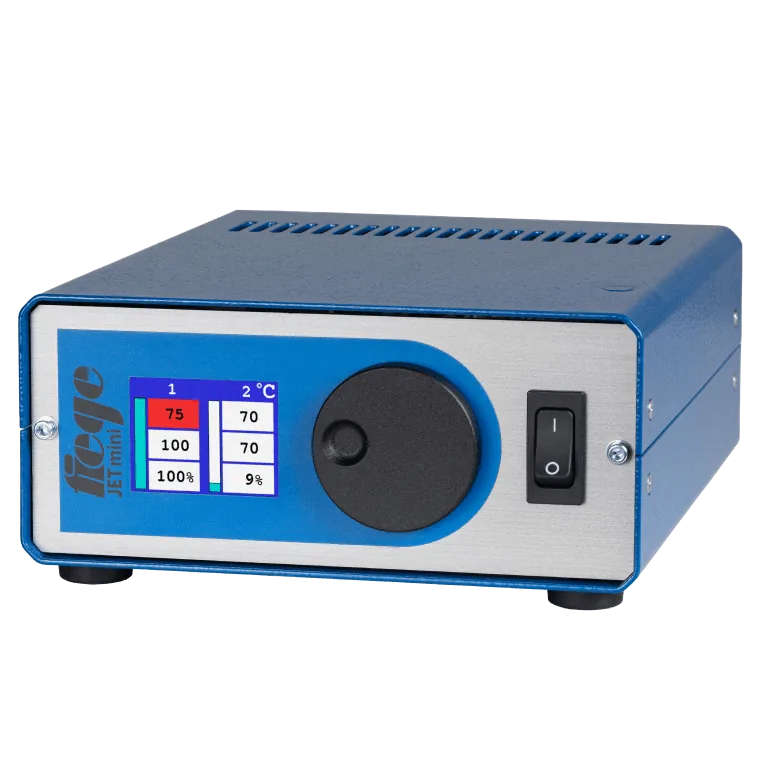
- [JETmini](/en/category/jetmini-series) — compact series, an economical solution for molds with few zones
- [TP and VARIO series](/en/category/tp-vario-series) — modular design, medium and multi-zone systems
- [JETmaster TP](/en/category/jetmaster-tp) — top-level control with touchscreen, comprehensive fault diagnostics
A good controller does not just heat: it detects thermocouple breaks, heater faults and leakage current, and brings damp heaters into service by drying them out with soft start.
Needle Valves and Cascade Sequential Injection
With a standard (open) nozzle the gate mark is small but present. In a needle valve system the gate of each nozzle is opened and closed mechanically by a needle: the mark is almost invisible and the flow is fully under control.
The real power lies in opening the needles in sequence (cascade): in long parts (bumpers, door panels, profiles) the nozzles open one after another as the melt front advances. The collision of two fronts is prevented — the weld line disappears and the clamping force requirement falls. NVS needle valve control units manage this scenario from 4 up to 32 channels.
In-Mold Measurement: Making the Process Visible
Cavity pressure measurement systems (e.g. DMS 4) monitor the real pressure curve inside the mold: the switchover from filling to holding is optimized with data, and every shot is recorded. In cascade systems, setting the needle opening moments according to pressure data turns trial and error into measurement.
Summary
In high-volume, multi-cavity or large-surface production, a hot runner quickly pays for itself through material, cycle and quality gains. For choosing a controller suited to your existing mold, or for your cascade projects, contact us.