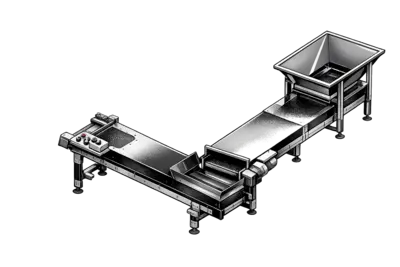
The part has come out of the mold — then what? In many plants the answer is still "it drops into a box, and the operator empties it now and then". Yet the few meters between the machine and the box are the cheapest and fastest-returning step in automation.
What Does a Conveyor Gain You?
- Uninterrupted cycle: No waiting for a full box, and the operator does not have to rush to keep up with the machine — a precondition for unmanned running on the night shift
- Part quality: Parts do not pile up on top of each other and get scratched; hot parts cool along the belt and drop into the box without deforming
- Counting and order: Changing boxes by shot count, batch separation and traceability become easier
- Labor: The number of machines per operator increases
Basic Conveyor Types
Below-machine flat belt: The most common type — sits under the clamping unit and carries the falling part to the side. Low-profile designs fit into small clamping unit openings.
Incline (Z/L type) conveyor: Lifts the part from the floor to box level. Cleats on the belt stop the part from sliding back.
Sorting conveyors: Systems with a rotating separator or twin belts for separating runners from parts; the separated runner goes straight to the granulator and enters the regrind loop.
Cooling belts: With a long body and fan modules, they give hot parts cooling time before boxing — preventing deformation in thick-section parts.
Metal-controlled lines: On the scrap line going to regrind, broken blades and inserts are caught right at the source with an above-belt magnetic separator.
Robot and Cell Integration
In robot cells the conveyor is the robot's drop-off station: the robot separates the part from the runner and places it on the belt, and throws the runner into the granulator. Ordered transport opens the door to counting, camera inspection and boxing automation. The conveyor speed is synchronized with the machine cycle — belts that advance in steps (indexing) on the shot signal fill boxes by part count.
Points to Watch When Choosing
1. Belt width and length: Part size + drop spread; the clearance under the clamping unit 2. Belt material: A heat-resistant belt for hot parts; an oil-resistant surface for oily applications 3. Speed control: Variable speed and cycle synchronization — the cheapest fixed-speed belt often becomes the bottleneck 4. Load and part weight: The motor and frame are sized accordingly 5. Hygiene/static: Medical and electronic parts need an antistatic belt
The Conveyor Within the Whole Line
Part handling is the last link in cell automation; before it come raw material conveying, raw material drying and dosing. Planning the cell as a whole — thinking about the conveyor in the layout from the start instead of squeezing it in later — saves both space and cost.
For a conveyor configuration suited to your parts and cell layout, contact us — we offer solutions sized to your machine park.