Plastic Granulators Products(7)
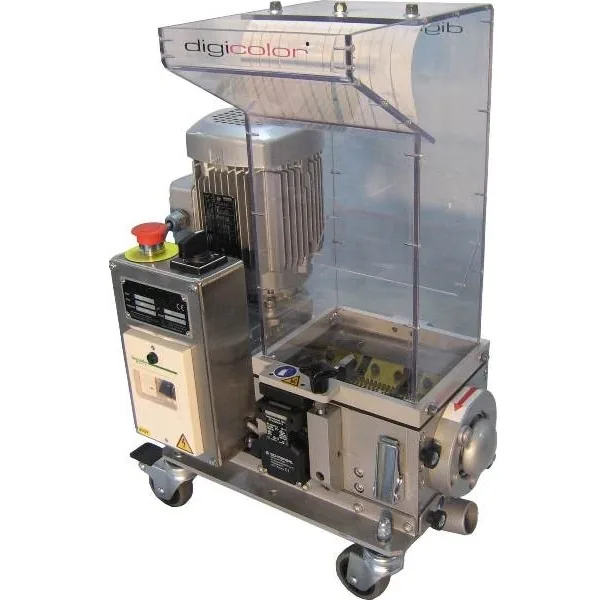
Plastic Granulators
A granulator is the machine that makes runners and scrap parts usable in production again. Chosen correctly it lowers the raw material cost; chosen wrongly it introduces problems into production.
Why does grinding quality matter?
The particle size and the dust content of the regrind determine what happens when you return it to production. An irregular particle size shifts the mixing ratio, because it makes the bulk density vary in the dosing unit. Dust sticks to the desiccant in the dryer, accumulates in the conveying line and bridges in the feed zone.
For that reason what is decisive in selecting a granulator is not the hourly capacity but the quality of the regrind.
Low speed toothed roller design
A classic knife mill breaks the material by striking it at high speed; it produces heat, noise and dust. A toothed roller mill cuts the material at low speed. The dust is reduced noticeably, the particle size becomes uniform and the noise falls.
Digicolor Goliath granulators work on this principle. The series runs from the Mini Goliath, working at 25 rpm with 0.55 kW, to the Titan Plus for large volume parts.
When selecting a granulator
| Question | What it determines |
|---|---|
| What is the largest dimension of the part? | The throat of the cutting chamber; if the part does not pass, a larger model or a feeding system |
| How many kilos will be ground per hour? | The motor power and the length of the cutting chamber |
| Where will it be installed? | If it has to go under the mold, a model with screw discharge |
| Is there a risk of metal coming with the material? | A metal detector system |
| Is the material abrasive? | Wear-resistant coating on the cutting elements |
Metal causes problems after the granulator too
A metal part coming with the material does not only damage the cutting elements; it is carried to the injection molding machine together with the regrind and reaches the screw and the mold. The metal detector in the granulator is the first line of defense; for protection further along the line you can look at magnetic and metal separation systems. We explained the whole subject in our article on metal separation and screw protection.
Returning the regrind
Grinding on its own is not enough. The regrind has to blend into the main raw material at a controlled ratio; for this a dosing unit is installed at the feed zone. If the accuracy of the ratio is critical and the weight ratios of the mixture are to be recorded, gravimetric dosing is preferred.
The moisture behavior of regrind is different from that of virgin material and its drying requirement is assessed separately; there is a counterpart on the material drying side. You can find the whole subject in our article on regrind and scrap recovery.