MuCell Weight Reduction Technologies Products(2)
 TREXEL
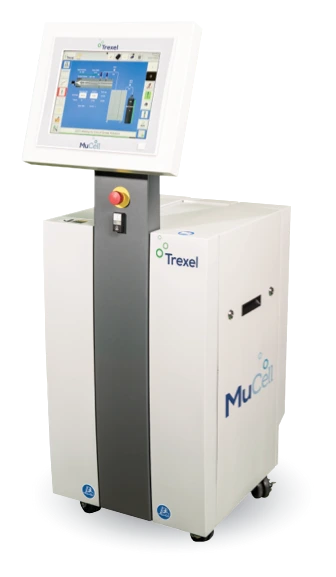
›Trexel T-Series Satellite Dosing Unit
- MuCell® supercritical fluid (SCF) dosing unit
- Precise high-pressure SCF injection into the melt
- Compact installation beside the injection molding machine
 TREXEL
›Trexel NC-250 Nitrogen Booster
- Central supply of supercritical nitrogen (SCF)
- Feeding several Satellite dosing units from a single booster
- Compact design, quiet operation, low maintenance
MuCell® — Microcellular Foam Injection Molding Technology
Trexel MuCell® is one of the most important plastics processing innovations of the last 20 years. In injection molding it creates a microcellular foam structure by injecting a supercritical fluid (SCF — usually nitrogen N₂ or CO₂) into the melt. Unlike chemical blowing agents it is a purely physical process: there is no temperature limitation and it leaves no chemical residue in the polymer; the parts are recyclable within their own polymer class and the regrind can re-enter the process.

The microscope image above shows the thousands of microcells formed with MuCell; these cells lower the density of the part and reduce internal stress.
How does it work? — Process diagram

1. SCF injection: Precisely dosed supercritical fluid (N₂/CO₂) is delivered into the polymer through injectors mounted on the plasticizing barrel. 2. Single-phase solution: In a special mixing section the SCF distributes homogeneously within the melt and forms a single-phase solution. 3. Injection into the mold: The melt is injected into the mold; the cells nucleate as they meet the low pressure. 4. Controlled cell growth: Controlled cell growth takes the place of pack and hold; growth stops when the mold is filled and a uniform internal pressure is achieved.
Benefits
- Weight reduction of up to 20% — less resin (raw material) consumption
- No sink marks and warpage is reduced noticeably
- Faster cycle time and higher output
- Lower clamping force → production on a smaller, more economical machine
- Design freedom: flow from thin to thick wall, a 1:1 rib structure
- Sustainability: low energy, low carbon footprint, recyclable parts
For which materials?
Almost all polymers except LCP gain a cellular structure with MuCell. Filled materials (glass fiber and similar) give the highest benefit; the filler works synergistically with the supercritical fluid. High temperature plastics such as PEEK, PEI and PSU also bring a significant cost advantage.
System architecture

MuCell consists of three main components:
- Satellite Dosing Unit (T-Series — T-S00 / T-S01): Positioned next to each injection molding machine; it doses the SCF precisely and delivers it into the melt at high pressure through the injectors in the barrel. It is sized according to the screw diameter of the machine.

- NC-Series Nitrogen Booster (NC-250 / NC-500): The central nitrogen compressor; a single booster feeds several dosing units. It works with bottled nitrogen, a nitrogen generator or liquid nitrogen; redundancy is built with a second booster.
- High pressure SCF injector and dedicated plasticizing unit: Positive screw position control and a shut-off nozzle.
Integration
MuCell can be integrated both into new machines (OEM Model) and into existing machines (MMU Model).
Fields of use
Automotive, consumer electronics, medical devices, packaging, white goods and technical engineering parts.
MuCell technology, system components and fields of application are on the TREXEL brand page.