In an injection molding plant the most dangerous moments often occur not during production but between production runs: while a five-ton mold swings on the crane, while a mold on forklift forks goes into a turn, while a machine is slid into its new position. When it is not planned, handling is both the biggest occupational safety risk and the most expensive item of damage — the bill for a dropped mold often exceeds the price of the equipment that should have carried it. This article looks at the safe ways of moving molds and machines and at choosing the right equipment.
A crane is not the answer to every problem
The overhead crane is the default tool for moving molds — but it has three structural limits. First, a crane does not reach everywhere: behind columns, side bays and the front of the mold shop rack are outside the crane's area in most plants. Second, a crane is a shared resource: when a mold change joins the crane queue, what is really waiting is press downtime. Third, and most important, the load swings under the hook, and a slinging error, slipping off the hook or a wrong center of gravity is a direct crushing risk. In well-planned plants the crane is reserved for jobs that require lifting the mold high; floor equipment takes over the load of horizontal transport.
The forklift, on the other hand, is a carrier not designed for molds: an unsecured mold slides on the forks, carries a risk of tipping over with its high center of gravity, and sensitive parting surfaces are damaged by knocks from the forks. It can be an emergency tool; it should not be the standard method.
Four classes of floor transport
| Equipment | What it does | Typical capacity |
|---|---|---|
| Mold transport cart | Carries the mold horizontally between the press and the mold shop on a fixed route | 2 - 30 tons (up to 500 tons in modular designs) |
| Heavy load platform transporter | Heavy loads on a free route; machine and large mold transfer | 10 - 50 tons |
| Battery-powered walk-behind transporter | Compact transfer with the operator walking alongside; tight spaces | Up to the 25 - 45 ton class |
| Drawer-type mold storage rack | Holds the mold in a drawer rather than on a shelf; access without a crane | According to mold weight per rack bay |
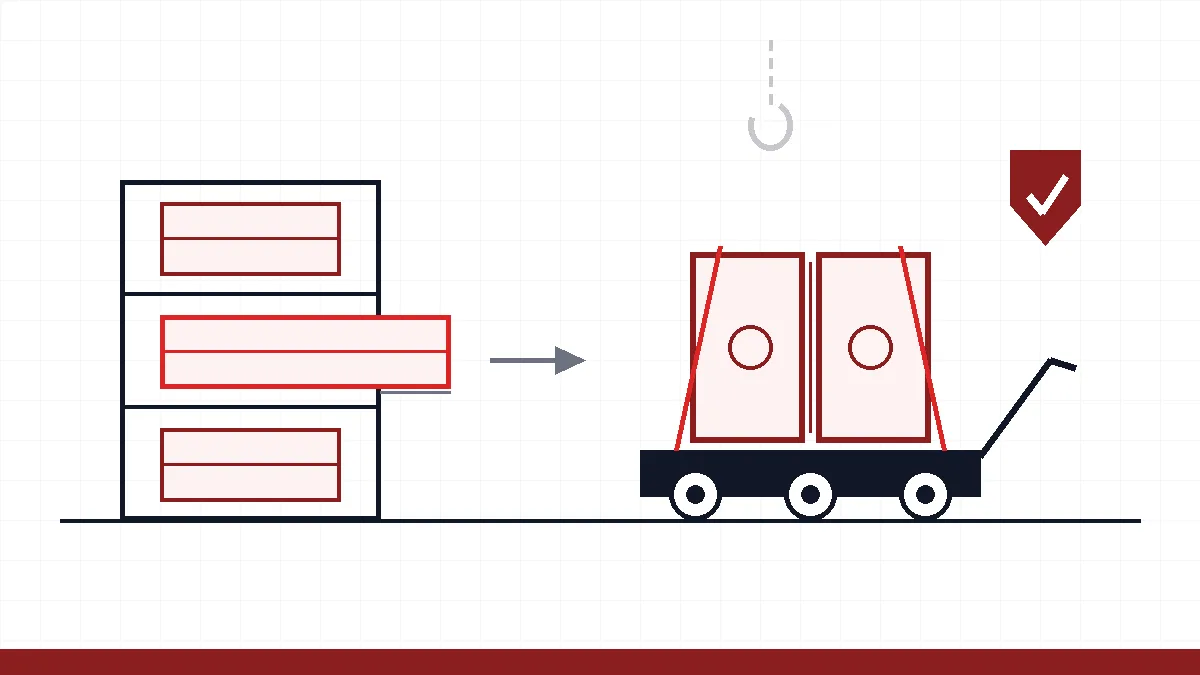
These classes are not alternatives to one another but links in the same chain: the rack drawer brings the mold out to the front, the cart takes it to the press, and the heavy platform transporter moves a new machine into place. For the products corresponding to the chain, see our transport and storage solutions page; opening and turning the mold safely in the workshop is a separate subject, covered by the mold tilting equipment and our mold maintenance guide.
Route engineering: the floor before the equipment
The questions that must be answered before choosing transport equipment concern not the equipment but the building:
- Floor load: how many kilograms per wheel does a 30-ton mold + a 5-ton cart press down? Does the concrete carry this at every point — especially at trench covers and expansion joints?
- Geometry: door widths, corridor turning radii, ramps and thresholds. No equipment should be ordered until the route of the heaviest mold has been walked through on paper.
- Parking and charging: the charging point of the battery transporter and the parking area of the cart; at the side of the route, not on it.
- Traffic separation: crossings between pedestrian walkways and the transport route must be marked; mirrors or sensors should be added at blind spots.
Moving machines: a project in its own right
Relocating an injection molding machine within a plant, or moving it to a new plant, is not simply a scaled-up version of moving a mold; it requires its own discipline. Knowing that the center of gravity is not in the middle of the machine body (the injection unit side is heavy), that the lifting points must be chosen according to the manufacturer's diagram, and that before moving the material in the screw must be emptied and the cylinders secured, is the difference between an accident and damage-free work. Production should not resume after the move until leveling and tie bar parallelism have been checked — a machine sitting at an angle opens the door to a series of silent problems, from mold safety to clamp wear. For jobs on this scale, our technical team provides support from the planning stage onwards.
Safety in writing: five rules
1. No one under the hook — while the mold is in the air, it is guided with a tag line, not by hand. 2. No unsecured load is moved — on a cart as on a forklift, the mold is mechanically secured; friction is not relied on. 3. Equipment capacity is verified by calculation, not by the label — the real weight of the mold must be known by weighing; "about five tons" is not engineering data. 4. The route is known in advance — a temporary obstacle, an open trench cover or a parked pallet is not discovered during the move. 5. The hand-over point between crane and floor equipment is defined — the moment the mold comes down from the crane onto the cart is the riskiest link in the chain; this area must be marked and kept clear.
We described how safety is guaranteed by hardware on the mold clamping side — including the crane plug interlock — in our 3200 ton case study; you can start the equipment assessment for your transport chain from the transport solutions page.