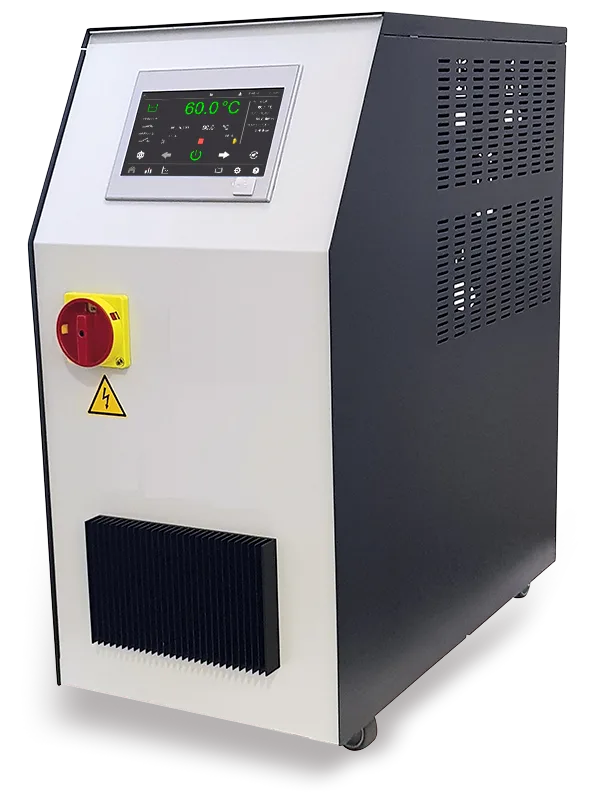
 3 models
Mold temperature control unit with direct cooling — 9 kW heating, 0.5 kW pump
- ✓ Electronic PLC control with a 7" touch screen and PID control
- ✓ Automatic temperature monitoring and limit value control
- ✓ Speck radial pump with mechanical seal
- ✓ Stainless steel cylindrical tank of about 36 liters
- ✓ Stainless steel heating elements and temperature sensors
TEMP 120 °C WDC Series — Direct Cooling
WDC (Water Direct Cooling) is the design in which the cooling water is taken into the main circuit directly rather than through a heat exchanger. It works in the 120 °C band.
The difference from a standard system
In a classic temperature control unit there are two separate water circuits: the main circuit going around the mold and the cooling circuit. The two meet through a heat exchanger; the heat transfer takes place across that intermediate layer, and this creates an unavoidable delay.
In the WDC there is no heat exchanger. The cooling water mixes directly into the main circuit and the intermediate layer in the heat transfer disappears.
The gain: response time
The difference is seen most at the temperature lowering stage. When the recipe changes, when the mold is to be cooled, or when a sudden correction is needed during the process, WDC systems respond noticeably faster. In production with short cycles and frequent product changes this is a direct saving of time.
Temperature stability also improves: because there is no delay caused by the heat exchanger, the control system corrects a deviation earlier.
The price: sensitivity to water quality
Because the cooling water mixes into the main circuit, the quality of the water directly determines the service life of the system. In standard systems the main circuit is closed and the water quality is set once; in the WDC, on the other hand, there is a continuous mixture of fresh water.
Risks and measures:
- Scale — deposition accelerates in hard water and the heat transfer falls; water softening is recommended
- Sediment and particles — filtration is essential, otherwise the mold circuits become blocked
- Corrosion — the water chemistry has to be monitored and an inhibitor used if necessary
If the water quality of the plant is not known, an analysis before the investment prevents maintenance costs arising later.
Who it is right for
Plants with frequent recipe changes, working with short cycles and with water quality under control. In plants with high water hardness and no water treatment infrastructure, standard systems with a heat exchanger cause fewer problems.
Brand and technology
The shared features of Rummel temperature control units — self-optimizing PID control, a 7 inch touch screen, communication with the injection molding machine over OPC-UA / Profinet / Modbus, and the multi-circuit distributor option — are explained in detail on the mold temperature control units page.
For a standard water solution you can look at the 90 °C series, and for a higher temperature at the 140 °C series.