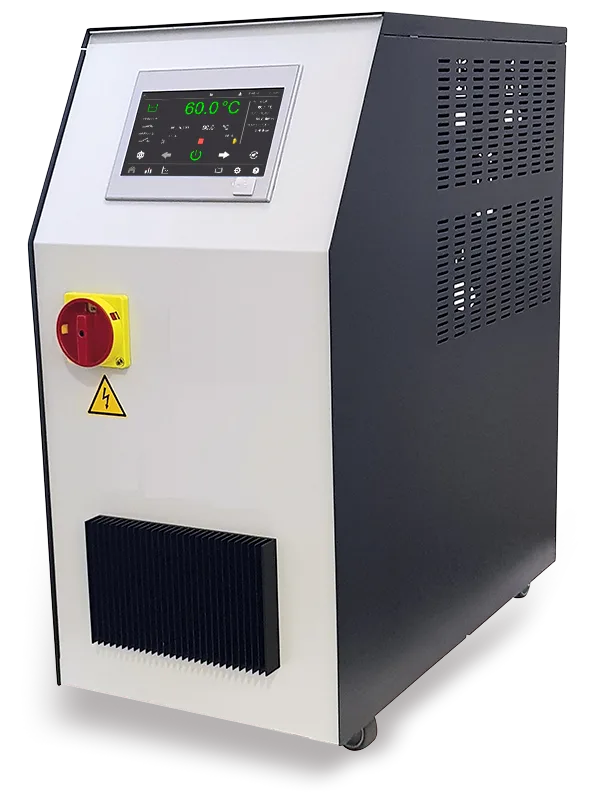
Pressurized water mold temperature control unit. Max. 160°C, 7" touch screen. 9 kW heating, 1.0 kW pump (60 l/min, max. 6.0 bar).
- ✓ Maximum 160°C water temperature (pressurized water, direct cooling)
- ✓ Magnetically coupled pressure pump (Speck)
- ✓ Indirect cooling — separate heating and cooling circuits with bypass cooling
- ✓ Stainless steel plate heat exchanger
- ✓ Stainless steel cylindrical tank (9.4 liters)
TEMP 160 °C Series — Pressurized Water Mold Temperature Control Unit
160 °C is the highest mold temperature that can be reached in practice with pressurized water technology. The special position of this series comes from that: it sits on the border between water and oil.
The value of being able to stay on the water side
The 160 °C limit is the last point at which you can keep the advantages water provides. The heat transfer coefficient of water is higher than that of oil — the mold responds faster to a change in temperature. The system is more economical, causes no cleaning problem in case of a leak, and has no maintenance items such as oil oxidation and periodic oil changes.
For that reason, in applications in the 150–160 °C band it is advisable to assess this series before moving to oil. Oil is only needed for temperatures water cannot reach safely.
Which applications call for this band
Engineering plastics requiring high crystallinity and some glass-fiber filled grades. In these materials raising the mold temperature improves the surface quality and the dimensional stability; in return it lengthens the cooling time. The balance between the two effects is established according to the part tolerances and the target cycle time — the calculation approach is explained in the cycle time guide.
Maintenance at this temperature
At 160 °C a pressurized circuit requires closer attention than low temperature systems:
- Sealing elements must be of a material suited to this temperature class and must be replaced periodically
- The safety valve has to be checked regularly and its operation verified
- Scale accelerates at high temperature; the hardness of the circuit water has to be monitored
- Insulation reduces both the energy loss and the burn risk
Safety
At a high temperature, pressurized water flashes to steam in case of a leak and creates a burn risk. It is essential that the connection points be positioned accessibly but protected, and that maintenance never be carried out without draining the circuit.
Brand and technology
The shared features of Rummel temperature control units — self-optimizing PID control, a 7 inch touch screen, communication with the injection molding machine over OPC-UA / Profinet / Modbus, and the multi-circuit distributor option — are explained in detail on the water and oil-based mold temperature control units page.
If a higher temperature is required, the move is to the 200 °C and 300 °C oil-based series.