 2 models
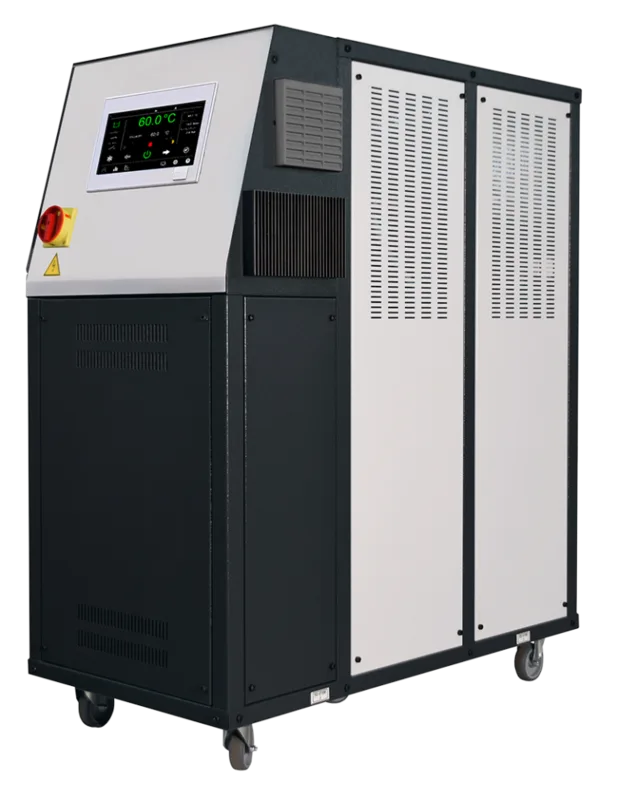
Oil-based XXL mold temperature control unit — 9 kW heating, 1.0 kW pump, max. 300°C
- ✓ Max. 300°C heat transfer oil temperature
- ✓ Electronic PLC control with a 7" touch screen and PID control
- ✓ Speck magnetically coupled pressure pump
- ✓ Closed tank system — stainless steel cylindrical tank (max. 20 l oil + 18 l expansion)
- ✓ Indirect cylinder cooling for the process circuit
TEMP-XXL 300 °C OIL Series — The Highest Temperature
An oil-based series working up to 300 °C; it is the top temperature class of the range. Standard and EXTRA versions are available.
When this temperature is needed
The 300 °C band is a requirement met in processing high performance engineering plastics. In these materials the mold temperature determines not only the surface quality but also the degree of crystallinity and the dimensional stability. Working below the target temperature directly lowers the mechanical properties of the part, and that loss cannot be made good afterwards.
Why the XXL body is needed
Applications working at this temperature are generally done with large molds of high thermal mass. The XXL class offers high heater power, a high pump flow rate and a large tank volume. The heater power determines how long it takes for the mold to reach the target temperature, and the tank volume determines the temperature stability.
Oil oxidation is far faster in this band
The rate at which oil degrades rises exponentially with temperature. At 300 °C oxidation is noticeably faster than in a system working at 200 °C; the oil change interval gets shorter accordingly. When it is neglected, the heat transfer falls first, then deposits build up in the circuit and the pump is strained.
In this series, oil analysis — viscosity and acid number — should be made part of periodic maintenance. Darkening of the color is the first warning, but it is not a sufficient criterion on its own.
Safety is the most critical subject
Oil at 300 °C carries a serious burn and fire risk in case of a leak:
- Connection points, hoses and fittings must be on a strict periodic check list
- Sealing elements are selected from materials specific to this temperature class
- Insulation reduces both the energy loss and the risk of contact
- No flammable material should be kept around the unit and a fire extinguisher must be accessible
- The circuit must be allowed to cool completely before maintenance
The EXTRA version
It offers extended capacity compared with the standard model; it is preferred in multi-circuit installations and those with a high thermal mass.
Brand and technology
The shared features of Rummel temperature control units — self-optimizing PID control, a 7 inch touch screen, communication with the injection molding machine over OPC-UA / Profinet / Modbus, and the multi-circuit distributor option — are explained in detail on the all mold temperature control series page.
For lower temperature requirements the 200 °C series, and for up to 160 °C water-based systems, are both more economical and faster responding solutions.