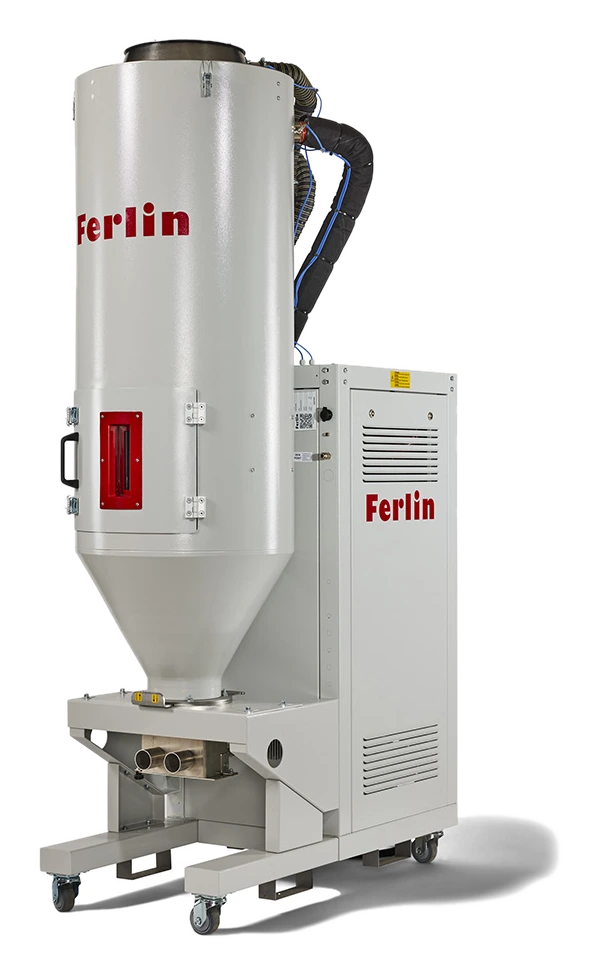
 12 models
High Temperature Dry Air Dryer
- ✓ High temperature (HT) execution — process temperature 50–170 °C
- ✓ Honeycomb (desiccant) rotor — a low and stable dew point
- ✓ Ideal for engineering plastics such as PA66, PC, PPS, PEEK, PEI, PSU and PPA
- ✓ Control panel with a graphic touch screen (HMI)
- ✓ RCE (anti-stress) function and a 3-step energy saving mode
Ferlin EasyDry HT — High Temperature Dry Air Dryer
The Ferlin EasyDry FED-HT series uses the same honeycomb rotor dry air (desiccant) drying technology as the standard EasyDry; but by raising the process temperature into the 50–170 °C range, it suits engineering plastics that have to be dried at a high temperature.
The difference from a hot air dryer
Hot air dryers remove only the surface moisture and fall short on hygroscopic (moisture-absorbing) plastics. Dry air dryers lower the dew point of the air to levels reaching –40 °C and remove the internal moisture of the granulate as well.
For which materials is HT (high temperature) needed?
High performance engineering plastics require drying in the 120–170 °C range; they do not dry sufficiently at the standard 80–120 °C:
- Requiring high temperature (HT): Nylon (PA66), polycarbonate (PC), PPS, PEEK, PEI (Ultem), PSU, PES, PPA, LCP
- Standard hygroscopic: ABS, PET, PBT, PMMA, TPU, PLA, ASA — the standard EasyDry is also suitable for these materials
EasyDry HT is offered in a hopper volume range of 30–1500 L, with a touch HMI, the RCE anti-stress function, energy saving modes and air flow rate options of 15–350 m³/h.
The HT version only makes sense for engineering plastics requiring a high temperature. For standard hygroscopic raw materials the normal version is enough: dryer types and selection table.
When the HT version is needed
Standard dry air dryers work up to 150 °C. Some engineering plastics, however, require a higher drying temperature: PA66, PPS, PEEK, PEI, PSU, PES, PPA and LCP are in this group. The HT version goes up to 170 °C and covers these materials.
The distinction is sharp: a standard dryer cannot reach a sufficient temperature with these materials and the moisture is not fully removed. The result is hydrolysis and a loss of mechanical properties during processing — and that damage is irreversible.
The PET side
PET drying is done in the 160–180 °C range with a residence time of 4–6 hours; the target moisture level is around 0.005%. In insufficiently dried PET the viscosity number falls, the part becomes hazy and a risk of bursting arises at the blowing stage. The subject is covered in detail in the article on PET preform production.
Over-drying causes harm too
Because the work is done at a high temperature, control of the residence time matters even more. Drying the material for a long time "to be on the safe side" leads to degradation and yellowing in materials such as PET and TPU. The time has to be set according to the manufacturer's data.
For standard requirements
If the temperature requirement is below 150 °C, the standard EasyDry is sufficient and more economical.