In an average plant a mold change takes 45–90 minutes. On a machine with two changes a day, this means 500+ hours of lost production a year. Quick mold clamping technologies bring this time down to 5–10 minutes. So, magnetic or hydraulic?
The Problem: The Hidden Cost of Bolted Clamping
In the conventional method the mold is fixed to the platens with bolts and clamps. At every change the operator removes and refits dozens of bolts; the time drags on, there is a risk of inconsistent torque, and working bent over inside the clamping unit creates an occupational safety problem. Today, with small-batch production growing and mold changes becoming more frequent, this is where the real loss lies: a machine that is standing still is not earning money.
Option 1: Electro-Permanent Magnetic Platen
Pressmag magnetic platens are platens with embedded magnets mounted on the machine platens. The mold is brought up and the magnets are activated with a current pulse lasting a few seconds — the mold is held over its whole rear surface with distributed force.
The critical safety fact: The system is electro-permanent — current is used only when changing state. Even if the power fails, the mold stays clamped; it does not drop like an electromagnet.
Advantages:
- The fastest method: clamping takes seconds
- No modification to the mold is needed — any mold can be clamped if its dimensions are suitable (no worries about standard clamp spacing)
- The force is distributed over the whole surface: no platen deformation and no single-point stress
- Continuous monitoring with temperature sensors and holding force monitoring
Limits: The mold back plate must be magnetic steel with sufficient contact surface; at very high mold temperatures (above 240 °C) a special version is needed.
In the EAS family, Pressmag SP is the standard version, LP is designed for large-tonnage injection molding machines, and FP is the waterproof (IP68) version for wet environments.
Option 2: Hydraulic Clamping Systems
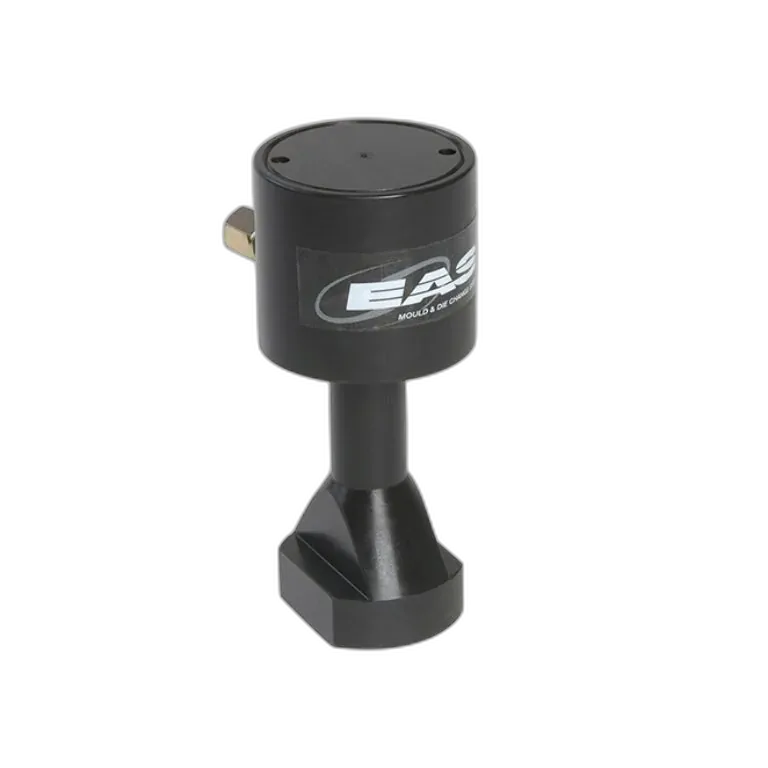
In a hydraulic system the mold is clamped with pull clamp cylinders or wedge clamps on the platen. The operator presses a button, and the cylinders pull and lock the mold.
Advantages:
- Trouble-free at very high mold temperatures (where magnetics are limited)
- Works with molds that are non-magnetic or whose back surface is not machined
- Adapts to different mold geometries with types such as MTR swing cylinders and the ELY rocker clamp
- In self-locking types the connection is maintained even if the pressure drops
Limits: The clamping edges of the molds must be standardized (EUROMAP compliance) — strong if the mold park is standardized, requires preparatory investment if it is mixed.
Decision Matrix
- Your mold park is very varied and not standardized → Magnetic platen (clamping without modification)
- Mold temperature above 240 °C → Hydraulic clamp
- Target of the shortest change time → Magnetic platen
- Molds to the EUROMAP standard, an automated line → A hydraulic system gives the same speed too
- Large tonnage (1000+ tons) → Both technologies can be applied; the LP magnetic has been developed for large platens
Holistic SMED: Clamping Alone Is Not Enough
Mold change time is clamping + transport + preparation. Mold transport and storage solutions (mold carts, storage racks) and maintenance equipment (inspection tables, mold turning units) speed up the other half of the process. If a preheating station is set up, the mold goes into the machine close to production temperature — and the transition to the first shot is shorter too.
For a magnetic/hydraulic feasibility study based on your mold dimensions and machine park, get in touch.