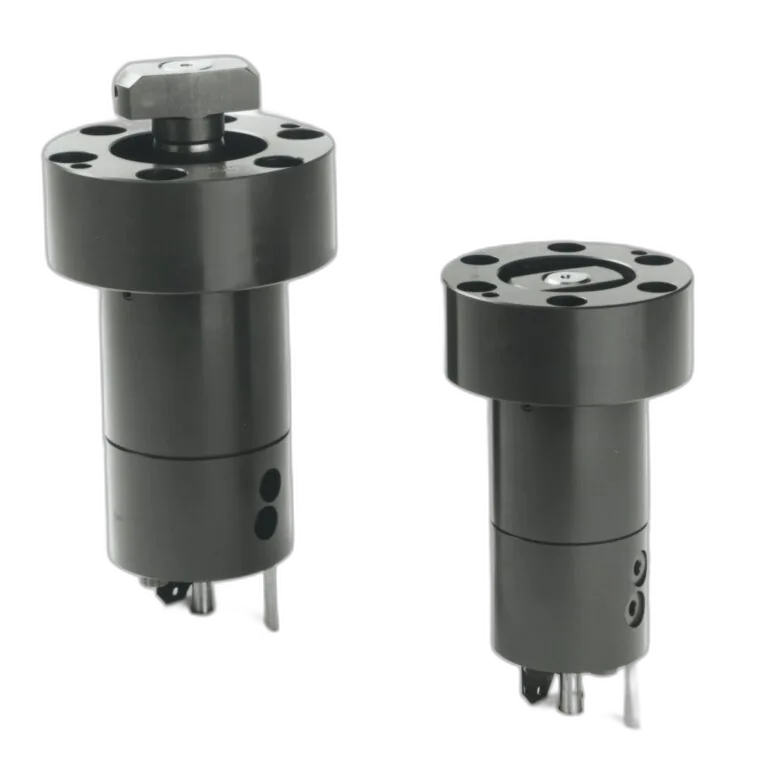
 3 models
MTR 3-Position Swing Cylinder. Double-acting, 3-position hydraulic swing cylinder — the clamping arm goes under the table and leaves the mold surface completely free.
- ✓ 3-position hydraulic clamp with 4 oil ports for extending, swinging, clamping and retracting
- ✓ Inductive sensor available for clamped and retracted position signals
- ✓ Mold connection fittings available
- ✓ Integrated clamping solution
- ✓ Control with two proximity switches
MTR 3-Position Swing Cylinders
The MTR series swing cylinders combine the four movements that extend, swing, clamp and retract the clamping arm in a single body. When the arm is fully retracted it hides under the work table — the platen surface is left completely free for loading and unloading.
Operating principle
The cylinder has 4 separate oil ports; each port controls one movement:
1. Extend — the clamping arm comes out 2. Swing — the arm swings into the clamping position 3. Clamp — the mold is fixed 4. Retract — the arm drops fully under the table
Technical specifications
| Operating type | Double-acting hydraulic, automatic operation |
| Control | Position management with 2 proximity switches |
| Sensor | Inductive sensor for the clamped and retracted positions |
| Models | MTR-51 · MTR-91 · MTR-141 |
| Accessory | Mold connection parts |
Where is it used?
Especially in applications where the press bolster has to be clamped automatically; it is preferred in new press installations where the bolster is to be secured even when no mold is present.
Because the arm hides completely under the table, it removes the risk of snagging during crane loading of the mold and makes the surface easier to clean.
Other hydraulic solutions: MOD / WOD · ECA · MHC · ELY · General information: magnetic mold clamping
What the retracting arm solves
A fixed clamp forms a physical obstacle in layouts where the mold is loaded by sliding it horizontally. In the MTR series the clamping arm is pulled completely under the table; the work table is left entirely free and the mold moves unobstructed on its rails.
Four oil ports, a controlled sequence
The cylinder works with four separate hydraulic ports: extend, swing, clamp, retract. Each movement is controlled separately; the sequence is defined in the hydraulic circuit. This matters because a movement in the wrong order — swinging before the arm has extended, for example — can damage the mold or the arm.
Position verification
The two proximity switches report whether the arm is in the expected position. Without that feedback the machine could start the cycle while the arm has not fully clamped; connecting the sensors to the press is essential for safety.
Models and selection
The MTR-51, MTR-91 and MTR-141 models cover different force and dimension bands. The selection is made according to the mold weight and the table geometry.
Where it is preferred
Layouts where the mold is loaded by sliding on rails, automatic mold change systems, and applications where the table surface has to be left completely free. Other hydraulic solutions are on the quick mold clamping page.