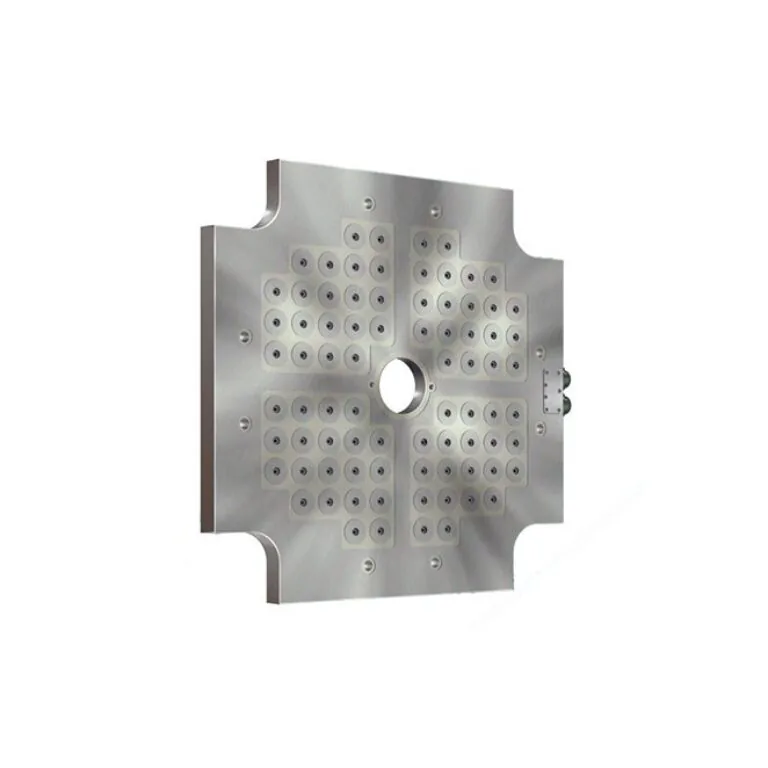
EAS Pressmag SP is an electro-permanent magnetic clamping system that offers a flexible clamping solution for injection molders who cannot standardize their molds. No electrical power is needed to hold the clamping force.
- ✓ Greater clamping forces
- ✓ Thinner plates
- ✓ Flexible adaptation to holes — more clamping force
- ✓ Maximum number of mounting screws — no air gap
- ✓ Standard temperature range up to 150°C
Pressmag SP — Thin Plate, High Clamping Force
Pressmag SP is the magnetic system that obtains a higher clamping force per unit area through a thinner plate and smaller poles.
Technical specifications
| Temperature range | Up to 150 °C as standard |
| Plate | Thin construction — takes up less of the machine opening stroke |
| Poles | Small poles — higher clamping force |
| Around the holes | Flexible construction around the holes, the clamping force increases |
| Rigidity | No bending occurs in the magnetic plate |
| Energy | No power is needed to hold the clamping force (electro-permanent system) |
What does an electro-permanent magnet mean?
The system uses electricity only at the moment of clamping and releasing. Once the mold is clamped the magnet holds its force even if the power is cut — there is no risk of the mold dropping in a power failure.
The thin plate construction takes up less of the machine opening stroke, which makes it easier to work with existing molds. The small poles, in turn, produce more holding force from the same area.
Other models: Pressmag FP (waterproof) · Pressmag LP (replaceable poles) · General information: quick mold change
Why the 150 °C limit matters
Magnetic materials lose power as the temperature rises, and above a certain threshold that loss becomes permanent. The SP series is designed for up to 150 °C; it comes into play exactly where standard plates fall short in applications running continuously with hot molds.
Thin plate, small poles
The SP is built around a thin plate and a small pole layout. This has two consequences: a higher force per unit area is obtained, and the plate flexes slightly around the holes to conform better to the mold face. On molds whose backplate is not perfectly flat, that flexibility becomes an advantage.
Electro-permanent safety
No power is needed to hold the force. In a power failure the mold does not move; energy is used only at the moment of clamping and releasing. Where a loss of pressure creates a direct risk in hydraulic systems, no such weakness exists here.
Selection
If the temperature does not exceed 150 °C and the variety of molds is wide, the SP is a suitable choice. If a wet environment and force monitoring come first, FP should be considered; if pole maintenance and heavy molds come first, LP.
The comparison of the magnetic and hydraulic methods is in the mold change time article.