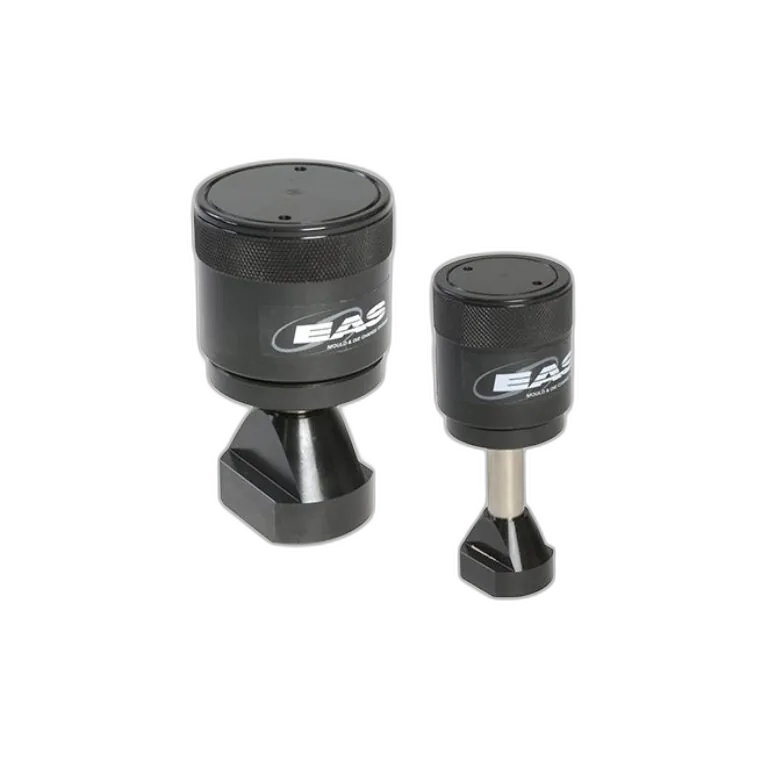
 5 models
MHC Pull Clamp Cylinder — MHC50-18-XX. 50 kN, 18 mm stroke, single-acting hydraulic hollow pull cylinder.
- ✓ Single-acting hydraulic QDC clamp
- ✓ Heavy-duty version
- ✓ Suitable for flat and non-flat surfaces
- ✓ Easy use with non-standard mold backplates
- ✓ Easy and safe clamping in hard-to-reach places
MHC Pull Clamp Cylinders
The MHC series are single-acting hydraulic QDC clamp cylinders working in a clamping force range of 40 – 250 kN. What sets them apart from the ECA series is that they also adapt to non-flat surfaces.
Technical specifications
| Clamping force | 40 – 250 kN |
| Stroke | 8 mm |
| Operating type | Single-acting hydraulic QDC clamp |
| Surface | Suitable for flat and non-flat surfaces |
| Backplate | Works with different thicknesses |
| Version | Heavy-duty option available |
| Positioning | Manually positioned cylinders |
Models
MHC50-18-XX · MHC-70-22-XX · MHC-70-28-XX · MHC110-28-XX · MHC110-36-XX
What does a non-flat surface mean?
Mold backplates are not always ideally flat; there may be machining marks, slight curvature or contamination. MHC cylinders adapt to these deviations and thereby ensure that the clamping force is transmitted in full. A clamp that does not grip completely on a non-flat surface cannot actually apply the force that looks sufficient on paper.
The 8 mm stroke tolerates the differences in mold backplate thickness.
For more compact applications see the ECA series.
Other hydraulic solutions: MOD / WOD · MTR · ELY · General information: quick mold change solutions
The uneven surface problem
In a plant whose mold park has been collected over the years from different makers, the backplates are rarely identical to one another. Some are not perfectly flat, some have local protrusions. The fundamental difference of the MHC series from the ECA is that it can also adapt to non-flat surfaces.
Technical data
It offers a force range of 40 – 250 kN and an 8 mm stroke. The short stroke keeps the body compact and the force is transmitted from a point close to the clamping surface. Heavy-duty options are available for high-tonnage presses; the series consists of 5 models.
Number and layout of the clamps
The number of clamps required is determined by the mold weight, its geometry and the press tonnage. The clamps must be distributed so as to hold the mold in balance; clamping from one side only can cause the mold to shift slightly during the cycle and produce flash at the parting line.
What the investment returns
A hydraulic clamp cuts a mold change that takes hours with bolted clamping down to minutes. In plants with small batches and frequent mold changes the payback period is short; you can see the cost of a lost production hour with the machine hourly rate calculation.
For a more economical and simpler solution the ECA series can be considered.