 9 models
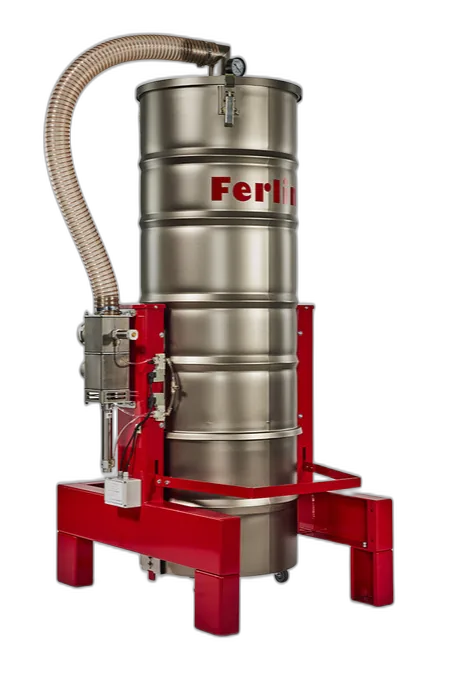
MOVAC 04M96.LR251 Claw Vacuum Pump — click for technical specifications and models.
Vacuum Pumps and Filter Units
The heart of a central conveying system is the vacuum source. The pump produces the air flow that carries the material along the line; the filter unit prevents the material dust from reaching the pump. A pump that has not been chosen correctly leaves the whole line inadequate.
Pump types
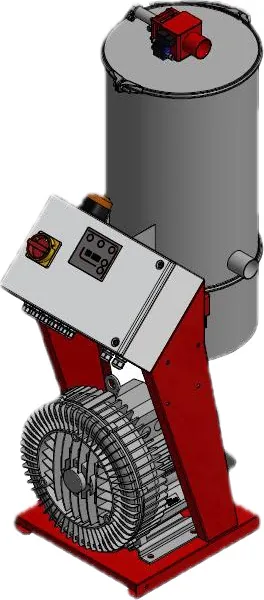
Side channel pumps — suitable for continuous running, quiet and simple to maintain. They are widely used on medium-distance lines and with standard consumption.
Claw pumps — these are dry-running, oil-free pumps. They are preferred for high vacuum and long conveying distances. Because the contacting parts do not touch one another the wear is low and there is no risk of oil contamination — which matters in food and medical applications.
Filter units
The fine dust generated during conveying is held in the filter. When the filter clogs the vacuum drops and conveying slows down; for that reason periodic cleaning or an automatic filter cleaning system is needed. Central filter units collect the dust of several lines at a single point.
How is the capacity chosen?
1. Total conveying distance — the sum of the horizontal and vertical lengths 2. Number of bends — every bend is an additional pressure loss 3. Simultaneous draw — how many loaders will call for material at the same time 4. Material density and grain size — heavy and coarse material calls for a higher vacuum 5. Pipe diameter — the line cross-section directly determines the flow rate
Insufficient capacity shows itself as longer conveying times, machines left without material and the formation of angel hair.
The system as a whole and its components: material conveying and loading systems · Loaders: Central Hopper Loaders
The vacuum source is the heart of the system
In a central conveying system all the loaders are fed from a single vacuum source. If the capacity of that source is insufficient, the machine furthest along the line does not find enough draw and is fed irregularly — the symptom is usually looked for at that machine, whereas the problem is in the central capacity.
The difference between side channel and claw pumps
Side channel blowers are simple and economical; they meet a medium vacuum requirement. Claw pumps, on the other hand, run oil-free, produce a higher vacuum and are better suited to continuous operation. Being oil-free removes the risk of oil vapor mixing into the raw material, which makes them the preferred choice in food and medical applications.
Why the filter is critical
Dust entering the vacuum line creates wear and a loss of efficiency if it reaches the pump. Central filter units hold that dust back; but a clogged filter also means a drop in capacity. Filter maintenance is the most frequently neglected and most frequently misdiagnosed maintenance item in central systems.
The symptoms of insufficient capacity
- Machines at the far end of the line being fed late or incompletely
- Conveying slowing down when several loaders run at the same time
- The pump running continuously and never stopping
If these symptoms are seen, the simultaneity calculation and the condition of the filter should be reviewed together. The system design is explained on the central material conveying page.