Big Bag Handling and Unloading Systems Products(3)
 Indus
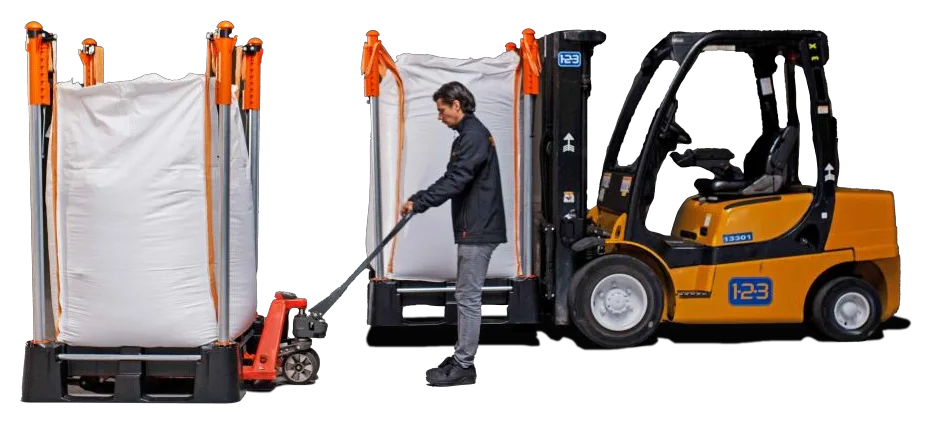
›Indus NEVA Big Bag Carrier
- 1,500 kg load capacity
- Stacking up to 7 meters
- Compatible with forklifts, stackers and pallet jacks
 Indus
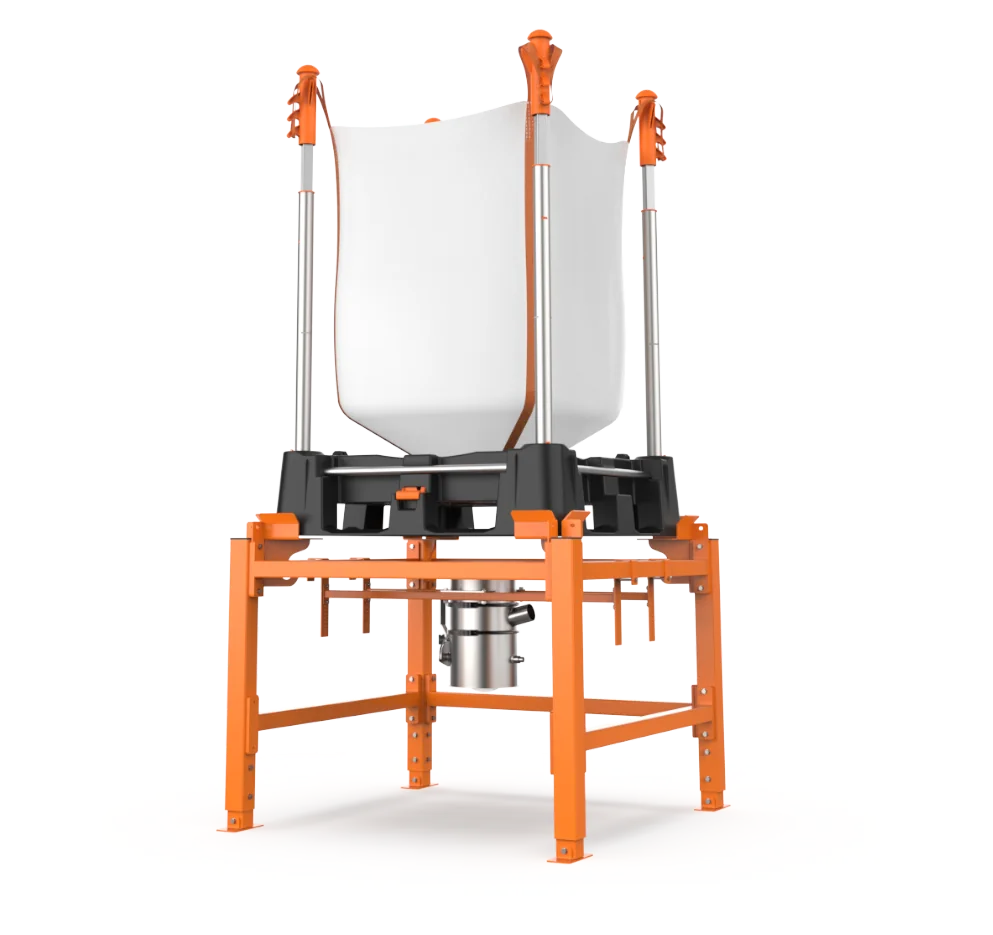
›Indus NEVA Big Bag Unloading Station
- No crane or hanging needed, loaded by forklift
- The big bag empties in less than a minute
- Loads up to 1,600 kg, 880–3,180 mm working height
 Indus
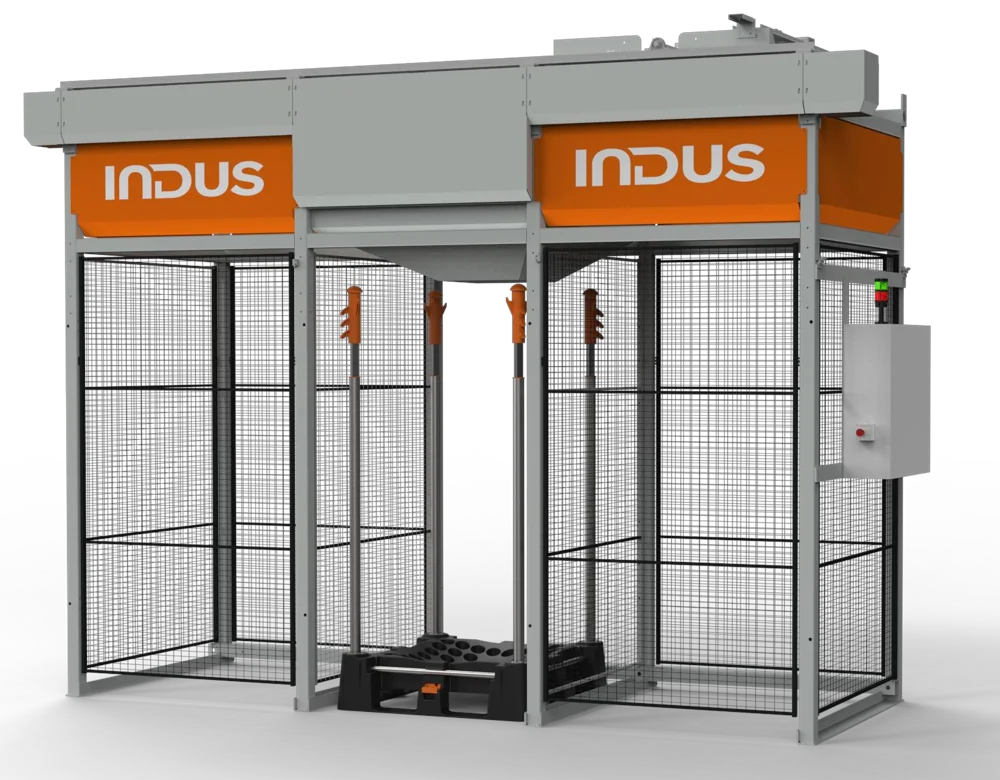
›Indus TUNGA Bag Opening Machine
- 2.5–3 tons per hour (depending on material and bag type)
- Lifts the bags with hooks and opens them automatically
- Stops by itself when the big bag or hopper is full
Big Bag Handling and Unloading Systems
In plants that receive raw material in 1,000–1,500 kg big bags (jumbo bags), the big bag itself is the difficulty: a big bag cannot stand on its own, cannot be stacked, and emptying it usually requires a crane and slings. Working under a suspended load is also one of the riskiest moments in terms of occupational safety. Indus systems keep the big bag on a single carrier from the moment it is received until it is fed to the machine: on the first day the big bag is set on the carrier, and on that carrier it is stacked in the warehouse, moved by forklift and emptied at the unloading station.
| Product | Role | Where it comes in |
|---|---|---|
| NEVA Big Bag Carrier | Keeps the big bag upright; transport, stacking and storage | Goods receiving and warehouse |
| NEVA Big Bag Unloading Station | Takes the carrier by forklift and discharges the material into production | Production area |
| TUNGA Bag Opening Machine | Opens 25 kg bags automatically and empties them into a big bag or a silo | Plants using bagged raw material |
In the warehouse: NEVA carriers can be stacked on top of each other; the stack reaches up to 7 meters. The manufacturer states that stacking saves up to 80% of warehouse space. Empty carriers are dismantled without tools and the space they occupy shrinks by 90%; a truck holds more than 100 empty systems.
In production: the unloading station empties the big bag without a crane, using only a forklift. When the slide in the carrier base is opened, the material flows to the outlet underneath the station. With a vacuum container fitted to the station, the outlet is connected directly to the central material conveying line, and the material is drawn by vacuum to the dryer or to the hopper loader on the machine. For poorly flowing materials (regrind, flake, powder), the Flow Head of the carrier pulls the big bag upward and forms it into a cone; a vibrating platform is used for the same purpose.
Questions to ask when selecting:
1. Big bag weight: the carrier takes loads up to 1,500 kg, the unloading station up to 1,600 kg. 2. Big bag size: the carrier is configured for big bags with a width and length of 70–120 cm and a height of 40–230 cm; pole length and head type are selected accordingly. 3. Working height: the leg set of the station is selected according to the equipment underneath it (vacuum container, dosing container, hopper); it is adjustable between 880 and 3,180 mm. 4. Number of materials: you need as many unloading points as there are different materials being fed at the same time; stations can be connected side by side. 5. Food and pharmaceuticals: a virgin PP base and stainless steel poles are selected.
For plants that empty bagged raw material by hand, the sack emptying station is sufficient; as the number of bags grows, TUNGA automates the job. Teknik Part is Indus's partner in Turkey; if you share your material types, consumption and big bag dimensions, we will work out together how many carriers and stations you need: technical support.